Discover Regional Cuisine & Slow Food in Garmisch
Regional Cuisine & Slow Food in Garmisch: What Gourmets Can Expect in the Coming Season
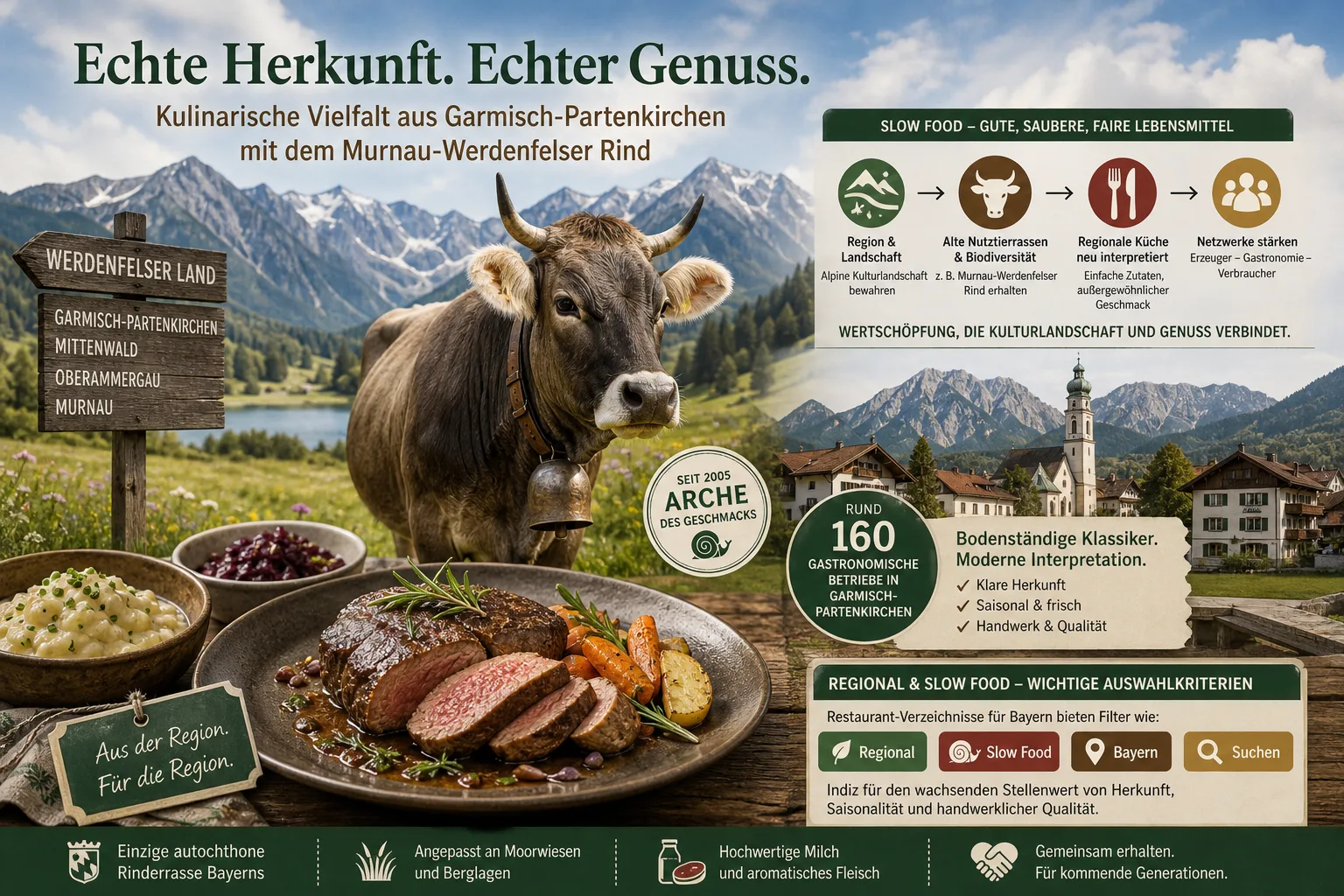
In the coming months, much in Garmisch will revolve around one question: How can Alpine cuisine be designed to remain enjoyable, transparent, and sustainable at the same time? Anyone strolling through the town soon will likely see menus more often that make origin, seasonality, and artisanal processing visible—and thus strengthen exactly the idea that Slow Food stands for: “good, clean, and fair.”
The focus will repeatedly be on a regional specialty: the Murnau‑Werdenfelser cattle. In the coming season, it is likely to appear even more often in gastronomy as a consciously designated ingredient—not as a trend, but as part of a culinary strategy that more closely connects landscape management, agriculture, and cuisine.
Alpine Cuisine in Garmisch: Trends for the Coming Season
In the next season, regional cuisine in Garmisch will likely be defined even more strongly by three principles: seasonality, transparency, and artisanal preparation. In practice, this means less “everything always available”—and more dishes that change with the course of the year.
What to Expect on Menus in the Coming Months
- More seasonal changes: Menus are likely to be adjusted more frequently at shorter intervals so that regional products can be used when they are available.
- More nose-to-tail and root-to-leaf approaches: Many kitchens will probably focus more on the complete use of animals and plants to combine quality, economy, and sustainability.
- Lighter interpretations of Alpine classics: It is expected that traditional dishes will be “lightened up” more often—such as with more vegetables, aromatic broths, and more precise cooking techniques.
Anyone who wants to eat regionally soon will therefore benefit most from menus that deliberately do not promise everything—but clearly communicate what is currently sensibly available.
Murnau‑Werdenfelser Cattle: Why It Will Become Even More Important
In the coming period, the Murnau‑Werdenfelser cattle will likely play an even more visible role in discussions about regional cuisine in the Werdenfelser Land—especially because, as a regionally rooted breed, it stands for a cuisine that not only claims origin but makes it explainable.
Why Demand May Increase in the Future
- Origin as a quality feature: Guests will likely ask even more about where meat and dairy products come from and how animal husbandry and feeding are organized.
- Fit with the Slow Food logic: Slowly braised preparations and clear product identity will continue to fit well with Slow Food principles in the future.
- Landscape management as part of the enjoyment experience: In the next season, stories about pastures, moor meadows, and regional cycles will probably become even more frequently part of guest communication—on menus, boards, or in service conversations.
Those who order consciously in the future will therefore probably find dishes more often that not only say “beef,” but provide a specific origin and a clear culinary idea (e.g., braised cuts, broths, ragouts, or finely portioned plated dishes).
Slow Food in Practice: How “Good, Clean, Fair” Becomes Tangible
In the coming months, Slow Food in Garmisch will become especially tangible where businesses make processes transparent: Who supplies whom, how are products processed, and how is this reflected in the taste?
How to Recognize Slow Food Thinking Particularly Well in the Future
- Product transparency: Menus will likely mention regional partners more often (e.g., cheese dairies, bakeries, butcher shops, or agricultural businesses) instead of just using general terms.
- Clear seasonality: “Sold out today” will be understood more as a positive signal in the coming seasons, as it indicates fresh, limited availability.
- Craftsmanship instead of shortcuts: More businesses will probably rely on homemade stocks, longer cooking times, and precise basic techniques in the future—because this makes quality more stable.
- Fairness as part of the calculation: If businesses transparently explain in the future why certain products have their price, this will build trust—without enjoyment becoming secondary.
For guests, this means: Those who want to enjoy consciously in the next season will benefit most if they not only ask for “regional,” but for concrete details—and also find these details on the menu.
What the Development Could Mean for the Town, Guests, and Businesses
If the trend towards regional cuisine and Slow Food continues to solidify in the coming years, it will likely influence several levels—from tourist perception to local value creation.
Possible Effects in the Coming Seasons
- For locals: It will likely become more attractive to choose local products in everyday life if restaurants, markets, and artisans make their cooperation more visible.
- For visitors: Garmisch will probably profile itself more strongly as a gourmet travel destination, where food is not just “incidental,” but is understood as part of the region.
- For gastronomy & producers: Shorter supply chains could become more stable in the future if planning (e.g., quantities, cuts, purchasing rhythms) is better coordinated.
- For culinary culture: It is expected that more businesses will again explain how dishes are created—and thus pass on knowledge about ingredients, seasons, and preparation.
At the same time, there will be challenges in the coming seasons: weather extremes, cost developments, and staffing issues will keep the implementation of regional concepts demanding. Precisely for this reason, comprehensible, well-communicated kitchen concepts are likely to gain in importance.
Practical Tips for Your Next Visits
If you want to specifically experience regional cuisine and Slow Food in Garmisch in the coming season, you are most likely to have good experiences with these decisions:
- Ask about seasonality: Actively request recommendations “from the seasonal menu” or for dishes that are offered precisely because of regional availability.
- Pay attention to clear origin information: Prefer menus that describe products specifically (e.g., breed/region/processing) instead of just claiming “from the region.”
- Choose braised dishes & broths: If you want to experience the principle of “time as an ingredient,” slowly cooked dishes will be especially typical in the coming months.
- Order flexibly: Expect that individual components may be sold out—and see this as an indication of real freshness and limited batches.
- Read reviews sensibly: In the future, pay less attention to superlatives and more to concrete notes on origin, craftsmanship, seasonality, and service transparency.
Outlook: Where Regional Cuisine in Garmisch Is Likely to Develop
In the coming years, regional cuisine in Garmisch will likely be strongest where enjoyment, ecology, and economic reality are brought together—without a moralizing tone, but with clarity.
Developments That Are Plausible in the Future
- More visible partnerships: Gastronomy and producers will probably communicate more closely how cooperation works (purchase quantities, cuts, ripening times, seasonal windows).
- More small portions, more variety: It is expected that plate concepts will emerge that offer less “large piece” and more aromatic variety around regional components.
- More culinary education: In guest communication, it will probably be explained more often in the future why certain ingredients are available when—and how this improves the taste.
Anyone who wants to explore Garmisch culinary in the coming season will benefit most if they not only want to “eat well,” but consciously look for the connection between landscape, product, and craftsmanship. This is exactly where Slow Food will have the most convincing effect in everyday life.