How Garmisch Is Changing – Culture, Tourism, Architecture
How Garmisch Will Change – New Cultural Venues and Ideas for the Coming Years
Garmisch-Partenkirchen is entering a phase in which culture, public space, building culture, and housing will be even more closely linked. In the next few years (especially from autumn 2026 and towards 2027), it will be decided whether the place, in addition to its nature and winter sports profile, will also continue to gain strength as an everyday cultural space for locals, employees, and guests.
Culture Becomes More Plannable: Programs, Series, and Formats from Autumn 2026
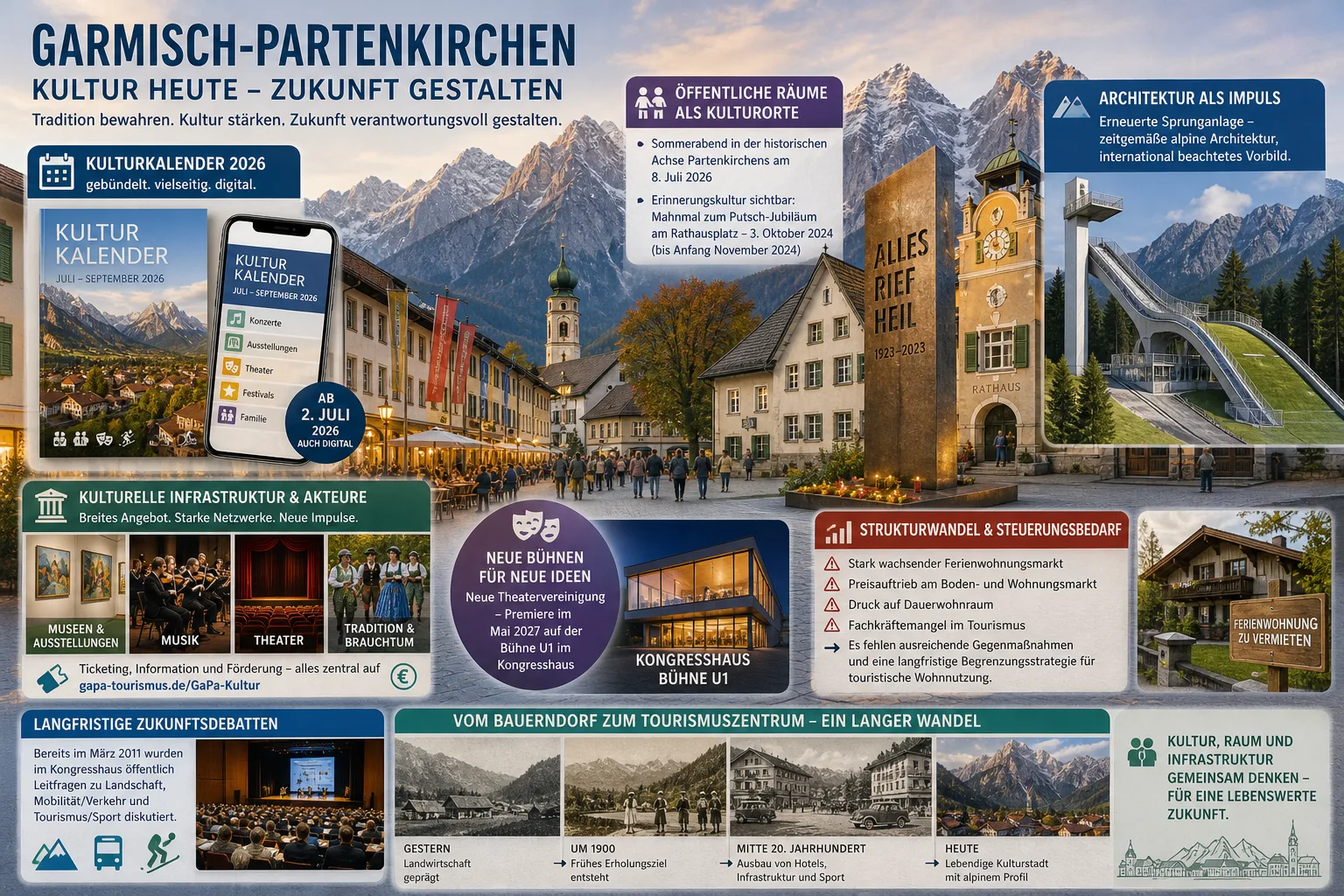
In the coming seasons, one thing in particular will change for many people: culture will become increasingly easy to plan in advance. The key to this is bundled programs and digital overviews that bring together dates, locations, ticket information, and target groups (family, concert, theater, exhibition, traditions).
From autumn 2026 onwards, it can be expected that event series will be more strongly curated: thematic focuses (e.g. “Alpine Modernity”, “City & Country”, “Nature & Sound”), recurring formats, and collaborations between associations, venues, and educational institutions. This has two advantages:
- Everyday suitability for locals: Those who work, have families, or commute benefit from clear series and early published programs.
- Orientation for guests: Culture becomes the second “reason to travel” alongside nature and sports – especially when it is easy to find and book spontaneously.
Practical tip: Those interested in upcoming dates should primarily use the official event calendars and the pages of municipal cultural work as well as the major venues (see sources). Updates and short-term changes are most reliably documented there.
Public Space as a Stage: What Could Change in the Future
A visible trend in the coming years is the cultural use of streets, squares, and transitional zones: short concerts, readings, pop-up exhibitions, participatory offers, or temporary “cultural islands”. Such formats are not just “events” but urban design: they test how quality of stay, mobility, and neighborhood can be combined.
For Garmisch-Partenkirchen, it is particularly relevant how the balance between traffic and encounter will be struck in the future. From autumn 2026, there could therefore be more frequent time windows in which individual areas are opened, slowed down, or repurposed for culture – for example, as traffic-calmed sections for evening formats or weekend series. Whether and how this succeeds typically depends on:
- Permits, noise protection, safety concepts, and emergency routes
- Accessibility (access, sightlines, toilets, public transport connections)
- Cooperation with gastronomy, retail, associations, and residents
If well implemented, a culture emerges that is not only consumed but creates relationships: people stay longer, meet by chance, discuss – and experience the place beyond classic postcard motifs.
Culture of Remembrance at the Center: How Upcoming Installations Can Spark Debates
The culture of remembrance will increasingly move into everyday life in many communities in the future – not only in museums, but in the form of temporary installations, audio formats, or guided tours that start at central locations. In the coming years, it can be expected that projects will also emerge in Garmisch-Partenkirchen that do not “file away” history, but ask questions of the present.
What matters here:
- Transparent classification: Who curates, who finances, which sources are used?
- Low access thresholds: short texts, multilingualism, low-barrier communication
- Dialogue formats: discussions, moderated evenings, school and youth offers
Well-done culture of remembrance strengthens trust because it shows: The place is ready to endure complex topics – and to derive attitude and willingness to learn for the future from them.
Cultural Infrastructure & New Actors: Networks, Funding Paths, Venues
From 2026/2027 onwards, cultural development in Garmisch-Partenkirchen will be determined less by individual events than by the question of whether an ecosystem remains stable: reliable spaces, fair framework conditions, funding knowledge, and cooperation.
What New Initiatives Will Need in the Coming Years
- Plannable space availability: rehearsal rooms, small stages, weatherproof alternatives
- Accessibility: arrival by public transport, safe footpaths, bicycle parking
- Professional basics: technology, ticketing, insurance, GEMA/license issues
- Networking: schools, music schools, associations, youth work, senior citizen offers
For audiences and participants, it is worthwhile in the future to pay attention to indications that signal quality and trustworthiness: clear responsibilities, transparent partners, comprehensible program lines, and easily accessible contact points on official websites.
Alpine Architecture as a Cultural Statement: What to Watch for in 2026/2027
In alpine locations, building culture is increasingly understood as part of cultural identity – not just as functional construction. In the coming years, debates about renovations, new buildings, and infrastructure projects will therefore be conducted more often on a cultural level: Which materials suit the region? How is energy used? How does the place remain habitable for different incomes and lifestyles?
For the period from autumn 2026, it is particularly relevant whether new or renovated buildings:
- enable public uses (e.g. multipurpose rooms, small stages, exhibition spaces),
- function year-round (not just seasonally),
- are planned to be low-barrier,
- and are operated resource-efficiently (energy, material cycles, durability).
Such decisions have a direct impact on culture: a well-designed forecourt invites people to linger before and after an event; a barrier-free entrance expands target groups; a flexible hall enables more formats – from theater evenings to citizens' assemblies.
Holiday Apartments, Real Estate Market, and Culture: Why Housing Becomes a Cultural Issue
The most important bottleneck for the cultural future is often not the stage, but the apartment. In highly sought-after tourist regions, rising prices, scarce permanent housing, and competition from tourist use can weaken the basis of cultural life – because people who organize, teach, maintain, serve, or technically enable culture must be able to live affordably in the long term.
For the coming years, questions will therefore become central that at first glance seem “only” real estate policy, but in fact influence culture:
- Will associations remain capable of acting if volunteers and young people move away?
- Will venues find staff (technology, service, organization) if employees have to commute long distances?
- Is there space for cultural education if families and young adults cannot find housing?
If Garmisch-Partenkirchen wants to stabilize its cultural dynamism from 2026/2027 onwards, it will be important not to consider cultural policy in isolation, but to think of it together with housing, transport, and location policy. Culture is then not an “add-on”, but part of public services: it holds the community together and creates understanding, especially when economic pressure increases.
Outlook: How Garmisch Could Sound in the Future
In the coming years, Garmisch-Partenkirchen can become a place that not only presents culture but anchors it in everyday life: visible in the calendar, tangible in public squares, serious in remembrance projects, supported by reliable spaces, and influenced by building culture and housing policy.
If the development succeeds, the “sound” of the place will become more diverse: dialect and international languages, classical concert evenings and low-threshold participatory formats, discussions about history and the future – and in between, a community that designs its public space so that encounters become more likely.
Those interested from autumn 2026 onwards should regularly use the official information channels, check programs early, and above all try out smaller formats. It is often there that the ideas arise that later shape the character of a place.