Discover Career Events & Job Fairs in Garmisch
Career Events & Job Fairs in Garmisch-Partenkirchen: How to Plan Your Next Step Between Zugspitze and the Future
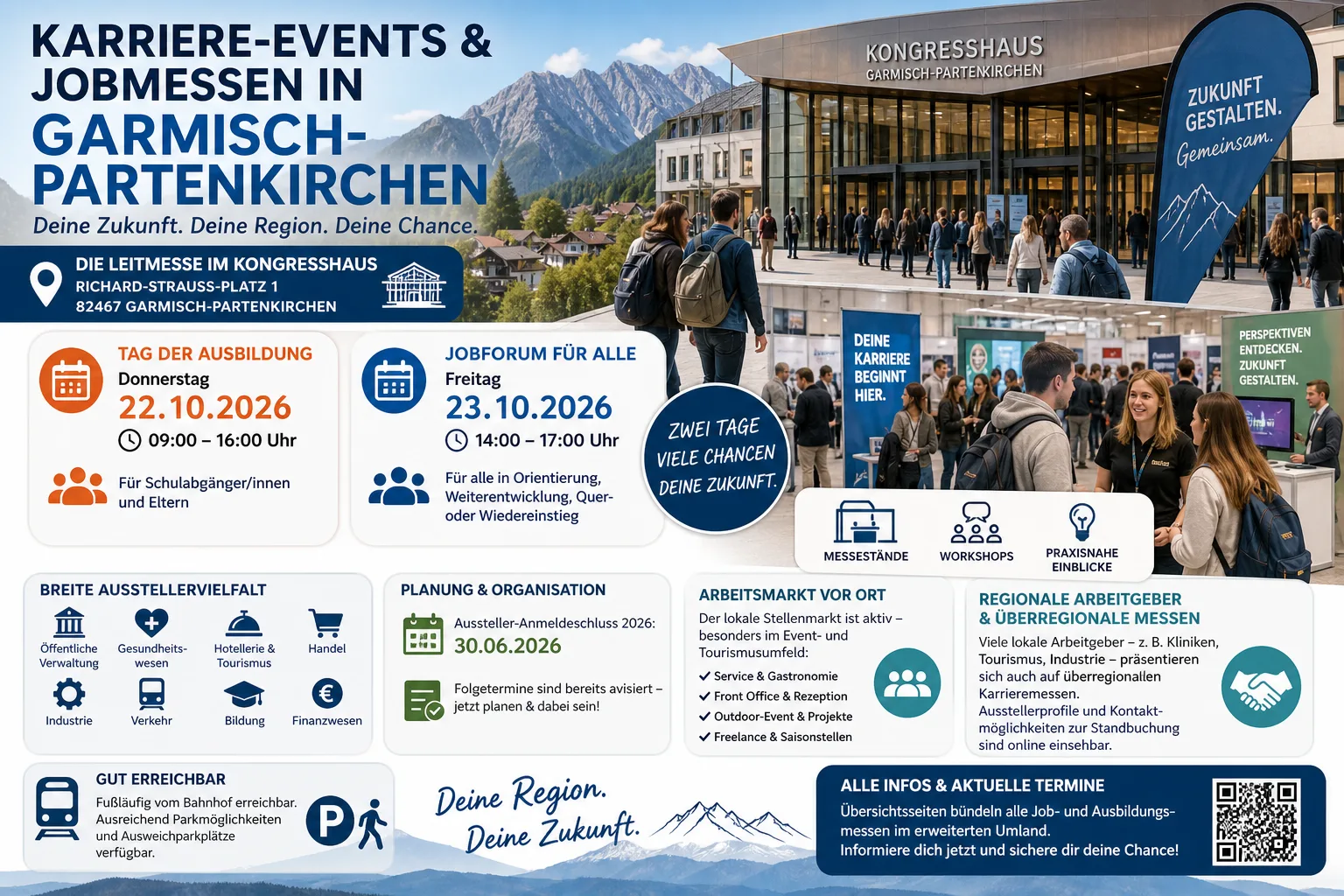
Anyone aiming for training, (re-)entry, or a new professional direction in the Garmisch-Partenkirchen region will particularly benefit from structured career events in the coming months. The focus will likely once again be a two-day flagship fair at the Congress Center, supplemented by counseling and information services on applications, further education, and regional employers.
This overview consistently looks ahead: Which formats you can expect soon, how to prepare, and how to derive concrete next steps from fair conversations.
Which Career Formats You Can Expect in Garmisch-Partenkirchen in the Future
Career events in Garmisch-Partenkirchen are typically designed to cover different life phases: from initial career orientation to reorientation with work experience. You will likely encounter mainly three types of formats:
- Flagship fairs with exhibitor booths (compact overview, many conversations in one day)
- Counseling and workshop offers (applications, interview training, profile and skills analysis)
- Information offers on training, retraining, and further education (paths, requirements, funding opportunities)
Specific dates are usually announced via the official organizer pages, municipal channels, and participating institutions. Therefore, plan to check the program details again shortly before your visit.
Flagship Fair at the Congress Center: Likely Hub of Upcoming Job and Career Days
The Congress Center Garmisch-Partenkirchen (Richard-Strauss-Platz 1, 82467 Garmisch-Partenkirchen) is often used as the central event location in the region. There, a flagship fair is usually set up so that you can compare many employers, educational providers, and counseling centers in a short time.
Day 1 (typical): “Training Day” for Orientation and Entry
The first day of the fair often focuses on training and dual entry paths. If this format is offered again, you will particularly benefit if you belong to one of these groups:
- Students shortly before graduation who want to narrow down a career field
- Parents/guardians who will support the decision-making process
- Teachers, coaches, and counselors who accompany career orientation
Meaningful goals for your visit will be: specifying professions, understanding requirements (school, internships, soft skills), and recording contacts with training companies so you can follow up quickly afterwards.
Day 2 (typical): “Job Forum” for Re-entry, Career Changers, and Professionals
A second day of the fair is often broader and more counseling-oriented. If a “Job Forum” is planned again, you will likely encounter topics such as:
- Re-entry after family time or a longer break
- Career change into shortage areas (e.g., service, nursing assistance, administration, tech-related roles)
- Part-time and flexible models
- Further education and recognition of skills
For conversations with employers, it will be helpful if you can explain your core competencies (technical and organizational) in two to three sentences—including what you want to avoid in the future and what you specifically want to pursue (e.g., predictable working hours, development, responsibility).
Which Exhibitor Profiles You Will Likely Encounter (and How to Compare Them Smartly)
The strength of a regional job fair usually lies in the mix. Instead of just one industry, you will likely meet employers and institutions from several sectors. For your comparison, it will be crucial that you ask the same criteria in every conversation (tasks, onboarding, development, working time models, location/commute, stability).
Public Administration, Education, and Social Services
Public employers and educational providers often appear at career events with clear career paths, structured entry routes, and transparent requirements. This will be interesting for you if you prioritize predictable development and reliable framework conditions.
Healthcare and Nursing: Entry, Transition, and Qualification
Institutions from health and nursing will likely advertise several entry points: training, assistant and support roles, therapeutic professions, as well as administrative activities. If you are considering a career change, you should specifically ask about qualification paths, recognition requirements, and shift/working time models.
Hospitality, Gastronomy, Tourism, and Event Environment
In a tourism region, hospitality-related employers will continue to be strongly represented. The fair visit will be particularly worthwhile for you if you:
- are aiming for an entry via service, reception, or guest support,
- want to grow towards team leadership, event organization, or revenue/back office in the medium term,
- want to clarify whether seasonal models or year-round roles suit you better.
In conversation, it will make sense to specifically ask about onboarding, duty scheduling, accommodation solutions (if offered), and further training (e.g., languages, leadership, event logistics).
Trade, Industry, Transport, and Financial Services
Additional sectors will help you check alternatives to the classic tourism profile. If you emphasize stability and transferable skills (organization, customer contact, technical understanding), you can often find suitable interfaces here.
Workshops & Practical Formats: What You Will Take Away for Your Next Step
Many fairs will not only offer booths but also a supporting program that will deliver usable results in a short time. If such offers are announced, you will benefit most if you plan them like “mini-projects”: set a goal, bring materials, secure the result.
Application & Self-Presentation (Practical Instead of Theoretical)
- Resume check: You will be able to use feedback faster if you bring a printable version (1–2 pages).
- Interview training: You will perform better if you prepare 2–3 STAR examples (Situation–Task–Action–Result).
- Online profiles: You will receive more invitations if you consistently sharpen your profile (e.g., tasks, results, keywords).
Practical Stations: “Testing” Job Profiles
If practical stations are offered, you will be able to recognize particularly well whether certain working methods suit you (e.g., hands-on, technical, service-oriented, administrative). Immediately afterwards, note three points: “liked it,” “surprised me,” “would avoid.” These notes will help you follow up.
Arrival & Procedure: How to Make the Fair Day Stress-Free
If the Congress Center is used as the event location, you will generally benefit from the central location. Still, plan for buffers: admission, cloakroom, peak times, and spontaneous queues at popular booths will affect your schedule.
- Timing: You will make more targeted progress if you first head for 3–5 “must-see” booths and only then act spontaneously.
- Documents: A short profile (resume + 5 bullet points on strengths/goals) will significantly speed up conversations.
- Contact management: You will want to note on the same day whom you spoke to and what the next step will be (e.g., application, trial day, callback).
Checklists: How to Turn Conversations into Real Options
Checklist for Students (and Parents)
- Set interest focus: You will find it easier to decide if you prioritize 2 career fields in advance.
- Prepare questions: You will get better answers if you ask specifically (tasks, vocational school, internship, permanent employment).
- Secure practical experience: You will gain clarity faster if you ask about internships, trial days, or holiday jobs.
- Follow-up: You will want to send a short email within 72 hours after the event (thanks + interest + next step).
Checklist for Experienced Professionals, Career Changers, and Returnees
- Competencies in 30 seconds: You will convince if you briefly state your role, your added value, and your goal.
- Clarify framework conditions: You will want to ask early about working hours, predictability, onboarding, and development.
- Check qualification: You should ask about concrete further training paths and funding opportunities.
- Consistent follow-up: You will turn conversations into offers if you firmly agree on the next step (appointment/contact person).
Classification: Why Career Events in Garmisch-Partenkirchen Will Remain Relevant for Your Future
Especially in regions with a high quality of life, the decisive question will be how work, family, housing, and mobility fit together. Career events will help you get reliable information faster—not just from job ads, but in direct conversation: about real work processes, team structures, expectations, and development paths.
If you use the fair as a starting point (orientation) and not as an endpoint (decision on the same day), you will benefit especially: You will collect options, prioritize, and then follow up in a structured way.