Youth Centers & Cultural Venues in Garmisch – PULS of Youth
Youth Centers & Cultural Venues in Garmisch-Partenkirchen: What's Coming Up for Children and Youth in 2026
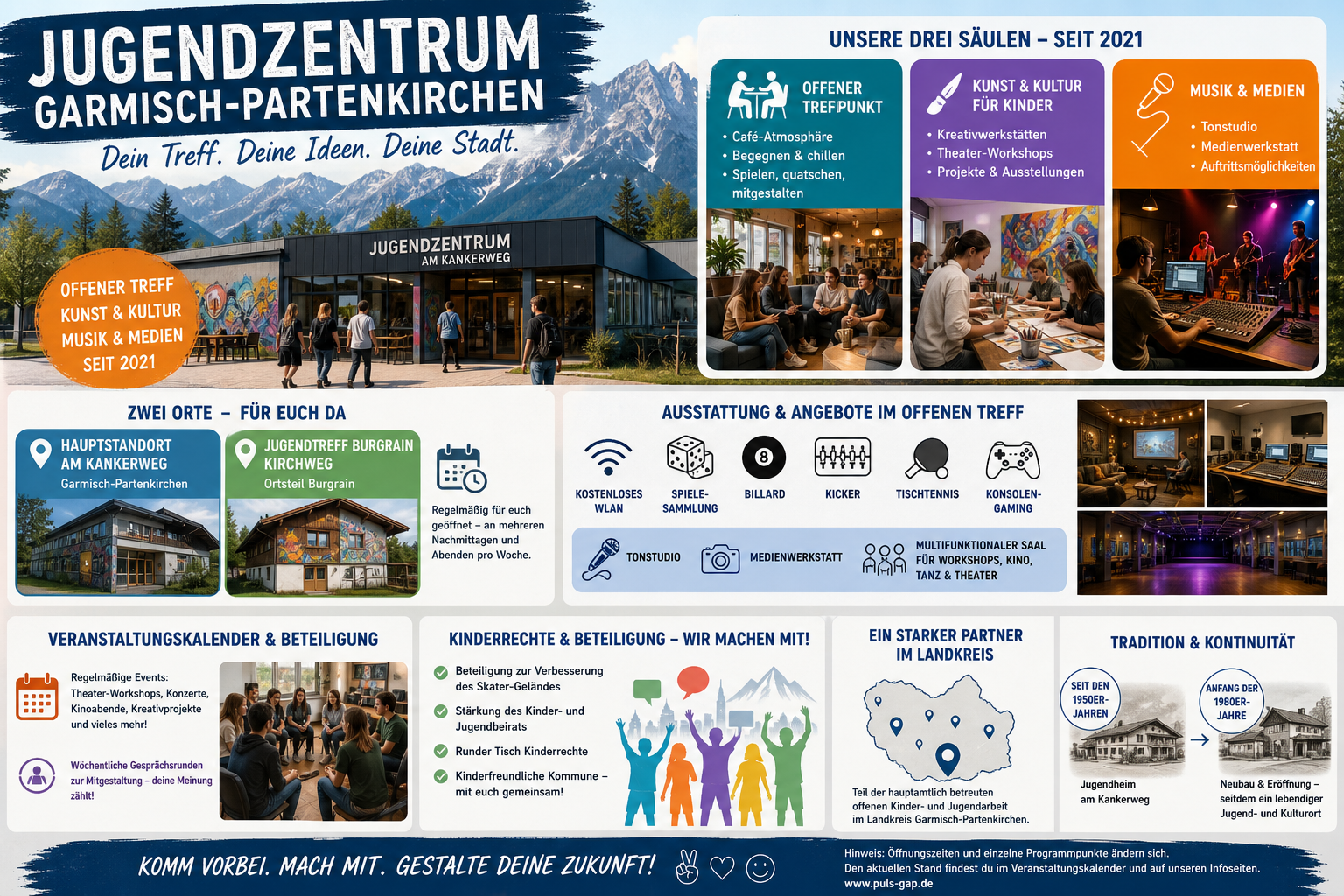
In Garmisch-Partenkirchen, youth work in 2026 is not just conceived as a "meeting point," but as a mix of open hours, cultural formats, media and music projects, as well as local participation. This overview summarizes which future offerings and development priorities will be in focus throughout 2026 in the environment of puls, youth centers in the districts, and projects like KuKUK.
puls: Open Meeting & Everyday Space
The name puls in Garmisch-Partenkirchen in 2026 stands above all for a principle: an open place where young people can arrive without barriers. The open meeting is more than just a "leisure program":
- Encounter: Meet friends, make new contacts, just be there.
- Retreat & Relief: A safe space where adults are approachable, without there having to be an immediate "problem."
- Everyday Offers: Play, sports, and creative opportunities that can be used spontaneously.
For 2026, it is especially crucial that open youth work retains its core: voluntary, low-threshold, life-world oriented. This is also the legal framework in which open youth work is anchored in Germany (including promoting the development of young people, connecting to interests, participation).
Culture, Music, Media: Formats Throughout 2026
In 2026, youth culture in Garmisch-Partenkirchen will likely be especially visible where children and young people not only "participate" but actively shape. Typical formats planned and continued throughout 2026 in the environment of youth centers and cultural initiatives include:
Music: From Idea to Track
Music formats in 2026 are often conceived as project tracks: Lyrics → Rehearsal → Recording → Presentation. It's not just about sound, but also about skills like teamwork, feedback culture, and responsible use of technology.
Media: Competent Instead of Just "Online"
In media formats, 2026 will focus on practical work: planning short clips, understanding image and sound quality, applying editing basics, and at the same time discussing rights (e.g., consent, personal rights). The goal is for young people not just to consume media, but to competently produce and reflect on it.
Culture & Creative Formats: Stage, Wall, Space
For 2026, cultural-educational formats are especially strong where they "open up" the space: small performances, open stages, small exhibitions, or community design actions. Such formats work because they have a low entry threshold (try it out) and still have a clear goal (show, share, celebrate).
Locations & Accessibility in the Districts
Even in 2026, open child and youth work in Garmisch-Partenkirchen will not only take place "centrally": In addition to the puls environment, meeting points in the districts are important so that distances remain short and participation does not fail due to mobility. Therefore, decentralized meeting times and activities will continue to play a central role throughout 2026.
To make planning work in everyday life, a fixed rhythm is worthwhile in 2026:
- Before the first visit: check current opening hours and age specifications (as holidays, events, or project phases may bring changes).
- For groups: for larger projects (e.g., band rehearsal, project idea, workshop), ask early which rooms are available when.
- For parents: clarify how the facility can be reached (transport/public transport, safe routes, pick-up situation), so that spontaneous visits remain possible.
Participation 2026: Have Your Say, Co-Plan, Co-Create
In 2026, participation in youth work is credible when it is concrete: Concerns are collected, prioritized, fed back, and transferred into processes. In this sense, the following participation paths are especially relevant in 2026:
- Open rounds at the meeting: Everyday topics (leisure spaces, meeting points, conflicts in public spaces) are taken up and structured.
- Project-based participation: When a place (e.g., sports/skate areas or recreation areas) is to be further developed, users are involved early on.
- Committees/Advisory Boards: Youth representations and youth-oriented dialogue formats ensure in 2026 that concerns do not remain at individual actions.
The benchmark for "good" participation in 2026 is not how big an action appears, but whether young people experience: My perspective is taken seriously, and something happens with it in a comprehensible way.
KuKUK & Other Cultural Venues: Projects Becoming Visible in 2026
Under the term KuKUK, culture-oriented approaches will be bundled in Garmisch-Partenkirchen in 2026 that make art and culture accessible and feasible for children and young people. Over the course of 2026, this will be especially evident where culture does not take place "at the top," but right in everyday life:
- Participatory projects (design, theater, music, media) with visible results.
- Cooperations between youth work, cultural actors, and, if applicable, schools/initiatives, so that resources (spaces, technology, know-how) come together.
- Actions in public spaces, when framework, permits, and protection concepts fit.
For 2026, it is especially important that cultural offerings do not depend on "perfection," but on participation, learning curve, and community. This creates places where creativity is not judged, but enabled.
Safety, Youth Protection & Support Services
Youth centers in 2026 are not just leisure venues, but also places of responsibility. This includes clear rules for respectful interaction, protection concepts, and approachable professionals. If young people or parents need additional independent advice during 2026, these services in Germany can help quickly:
- Nummer gegen Kummer (for children & young people as well as parents): anonymous, free of charge, low-threshold.
- TelefonSeelsorge: available around the clock for acute crises and the need to talk.
Note: This article does not replace individual counseling. In case of acute danger, please use the emergency call.
Sources
- Social Code (SGB VIII) § 11 Youth Work — legal framework for youth work (accessed 2026-05-20)
- UNICEF Germany: UN Convention on the Rights of the Child (Overview) — Classification of participation and rights of children and young people (accessed 2026-05-20)
- Child-Friendly Communities e.V. — Program framework for municipal child and youth participation (accessed 2026-05-20)
- Nummer gegen Kummer e.V. — anonymous counseling for children/youth and parents (accessed 2026-05-20)
- TelefonSeelsorge — 24/7 conversation offer in crises (accessed 2026-05-20)