
Hugo Harrer
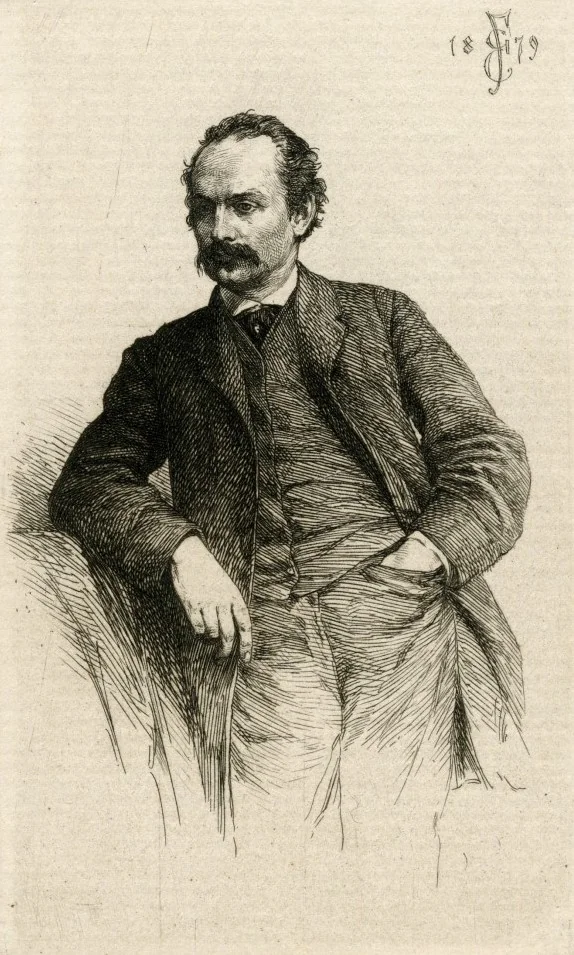
Image from Wikipedia
Image from Wikipedia
Hugo Harrer: The Silent Realist of the Düsseldorf School Between Rome, Nuremberg, and the Italian Coast
An Artist Between Architecture, Landscape, and Atmospheric Realism
Hugo Paul Harrer was a German landscape and architectural painter of the Düsseldorf School, born on February 6, 1836, and died on December 10, 1876, in Rome. His artistic journey moves from early architectural interests through self-taught studies in painting to a body of work characterized by realistic city views, motifs of ruins, and Italian coastal landscapes. This connection between architectural precision and painterly observation makes Harrer an intriguing figure in 19th-century German painting. ([de.wikipedia.org](https://de.wikipedia.org/wiki/Hugo_Harrer))
Biographical Beginnings: From Architecture Studies to Painting
Harrer initially intended to become an architect but soon turned to painting, developing as an independent artist without permanent academy visits or a fixed master. His first paintings were created in Nuremberg, where the picturesque architecture particularly inspired him. He subsequently moved to Munich, where he was captivated by the then-new realistic painting style of Carl Theodor von Piloty, which sharpened his vision for narrative pictorial spaces. ([deutsche-biographie.de](https://www.deutsche-biographie.de/sfz26126.html?language=de))
This early phase already shows how closely form and content were connected in Harrer’s work. Architecture did not merely serve as a motif but as a compositional foundation, allowing light, figure, and atmosphere to unfold. His training was thus unconventional, yet consistently focused on observation and pictorial truth. ([deutsche-biographie.de](https://www.deutsche-biographie.de/sfz26126.html?language=de))
Rome as an Artistic Center and Laboratory of Motifs
In 1861 or according to another source in 1862, Harrer went to Rome due to a chest ailment, where he joined Ludwig Passini and painted studies from nature. His early works, directly observed, drew attention for their great truthfulness. Rome became not only his residence but a permanent territory for sketches, studies, and compositional experiments. ([deutsche-biographie.de](https://www.deutsche-biographie.de/sfz26126.html?language=de))
The Italian capital and its surroundings provided him with the repertoire for realistically conceived architectural and landscape paintings. According to the Stiftung Sammlung Volmer, several trips within Italy fed this inventory of images, which he further processed in his oil paintings. Notably, his works feature close-up, vivid scenes populated with figures, characterized by strong contrasts of light and shadow. ([stiftung-volmer.de](https://www.stiftung-volmer.de/artist/321))
Düsseldorf and the Düsseldorf School
Between 1867 and 1868, Harrer stayed in Düsseldorf and studied in the landscape class of Oswald Achenbach at the art academy. From 1868 to 1872, he was a member of the Düsseldorf Künstlerverein Malkasten, an important institution in the art scene along the Rhine. These years solidified his connection to the Düsseldorf School, whose emphasis on landscape and atmospheric traditions continues to resonate in his work. ([de.wikipedia.org](https://de.wikipedia.org/wiki/Hugo_Harrer))
The Düsseldorf School emerged in the 19th century as an internationally influential phenomenon, significantly impacting landscape, architectural, and view painting. Harrer occupies a position in this lineage as an artist who seamlessly combines the academic discipline of composition with a modern, more accurately observed reality. His interest in ruins, street scenes, and Italian coastal landscapes fits well within the broad European perspective of this school. ([rheinische-geschichte.lvr.de](https://rheinische-geschichte.lvr.de/Epochen-und-Themen/Themen/die-duesseldorfer-malerschule-im-19.-jahrhundert/DE-2086/lido/57d1295fefdcc4.18641232))
Typical Subjects: Ruins, Street Scenes, and Italian Coasts
Harrer frequently chose picturesque angles in crumbling ruins and scenes from Italian cities. His paintings thrive on the tension between architectural order and the allure of the ephemeral, between stone structures and human embellishment. The realism of his representation is not marked by cold sobriety but by a precise, atmospherically dense pictorial language. ([deutsche-biographie.de](https://www.deutsche-biographie.de/sfz26126.html?language=de))
In surviving works such as Old Hanse from 1868, View of the Amalfi Coast at Sunset from 1871, and At the Marcellus Theater in Rome from 1876, this attitude becomes particularly evident. Even the motif of the Jewish street vendor in a street in Siena highlights Harrer's eye for everyday reality and figurative vitality. His painting connects topographical precision with narrative density. ([de.wikipedia.org](https://de.wikipedia.org/wiki/Hugo_Harrer))
Style and Artistic Signature
German Biography describes Harrer as “a thoroughly modern realist” who wanted to depict objects as he saw them and placed great importance on the nature of the pictorial representation. The quality of his oeuvre lies not in spectacular gestures but in careful nature observation, controlled composition, and a sensitive perception of space and light. This approach makes his architectural paintings as convincing as his landscapes. ([deutsche-biographie.de](https://www.deutsche-biographie.de/sfz26126.html?language=de))
The Stiftung Sammlung Volmer emphasizes that his architectural images typically depict closely observed fragments, filled with numerous figures and defined by strong contrasts of light and shadow. In this way, Harrer approaches a pictorial language that not only documents architecture but dramatizes and emotionally charges it. His work thus appears calm, precise, and remarkably contemporary even today. ([stiftung-volmer.de](https://www.stiftung-volmer.de/artist/321))
Reception, Collections, and Art Historical Classification
Harrer’s works were repeatedly sent to German art exhibitions and thus resonated within the art scene of his time. The ADB biography emphasizes that after his stay in Düsseldorf, he continued to collect studies from Rome and submitted several larger paintings annually. This demonstrates an artist who did not work on the periphery but was actively interested in the visibility of his work within the German art system. ([deutsche-biographie.de](https://www.deutsche-biographie.de/sfz26126.html?language=de))
Today, his works can be located in significant collection and documentation contexts, including Kunstsammlung Gera and the Nationalgalerie Berlin for specific named pieces. Additionally, the Stiftung Sammlung Volmer portal highlights a preserved painting, underscoring Harrer’s ongoing art historical relevance. Thus, he remains not only a biography but also a traceable part of 19th-century painting history. ([de.wikipedia.org](https://de.wikipedia.org/wiki/Hugo_Harrer))
Current Projects and Publications
As a 19th-century artist, Hugo Harrer has no current projects, albums, singles, or tours. His present presence lies in the reception of his works, collection records, art historical entries, and ongoing research on the Düsseldorf School. Therefore, the relevant “contemporaneity” of his name arises from museums, archives, and art historical documentation, rather than ongoing artistic creation. ([de.wikipedia.org](https://de.wikipedia.org/wiki/Hugo_Harrer))
Discography and Critical Reception
A discography in the musical sense does not exist for Hugo Harrer, as he was a painter and not a musician. Instead, the critical transmission of his artistry depends on catalogs of works, traces of exhibitions, and museum records. Critically, Harrer appears as a realistic image creator with a keen eye for architecture, nature, and urban atmosphere, whose works carry a clear signature within the context of the Düsseldorf School. ([de.wikipedia.org](https://de.wikipedia.org/wiki/Hugo_Harrer))
His cultural influence lies in the connection between architectural painting and landscape observation. Harrer not only documents places but condenses them into images of mood and time. This gives his work a quiet authority that remains interesting to collectors, art historians, and lovers of the Düsseldorf School to this day. ([deutsche-biographie.de](https://www.deutsche-biographie.de/sfz26126.html?language=de))
Conclusion: Why Hugo Harrer Remains Interesting
Hugo Harrer is an artist for those seeking not only motifs but also vision, observation, and atmosphere in painting. His realistic architectural and landscape images combine technical precision with poetic effect, demonstrating how vividly the Düsseldorf School influenced beyond national borders in the 19th century. Those who view Harrer’s works discover a painter who mastered the calm gaze and created enduring images. ([deutsche-biographie.de](https://www.deutsche-biographie.de/sfz26126.html?language=de))
This blend of discipline, nature observation, and Italian pictorial poetry makes Harrer fascinating. His works deserve to be rediscovered in museums, in catalogs, and in art historical discourse. Anyone interested in the Düsseldorf School, architectural painting, and 19th-century realism should definitely take a closer look at Hugo Harrer. ([de.wikipedia.org](https://de.wikipedia.org/wiki/Hugo_Harrer))
Official Channels of Hugo Harrer:
- Instagram: No official profile found
- Facebook: No official profile found
- YouTube: No official profile found
- Spotify: No official profile found
- TikTok: No official profile found