
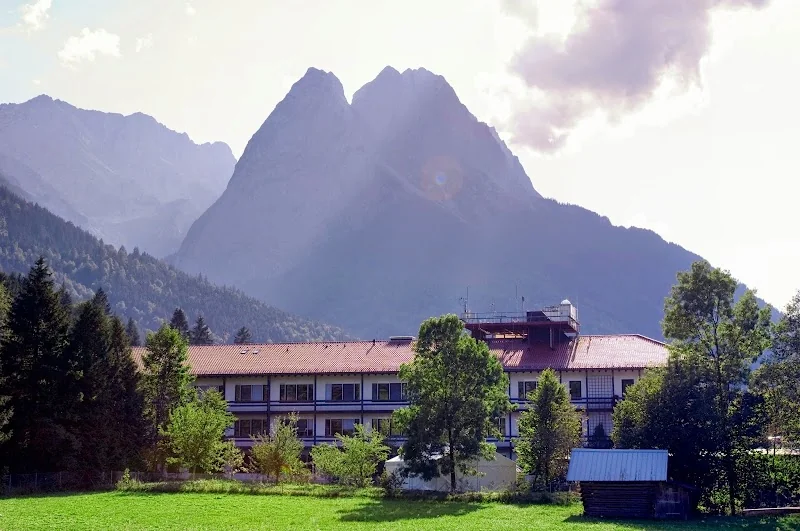
Kreuzeckbahnstraße 19, Garmisch-Partenkirchen
Kreuzeckbahnstraße 19, 82467 Garmisch-Partenkirchen, Germany
KIT Campus Alpin IMK-IFU: Climate Research, Access and Careers in Garmisch-Partenkirchen
The KIT Campus Alpin of the Institute for Meteorology and Climate Research - Atmospheric Environmental Research, abbreviated as IMK-IFU, is a scientific address with a special profile. It is located in Garmisch-Partenkirchen at the foot of the Alps, in close proximity to the Zugspitze, and thus at a place where climate research is not only theoretically conceived but also observed and measured in a unique landscape. The institute examines changes in the atmosphere, water balance, and living conditions for vegetation and society in the context of global climate change. At the same time, the campus serves as a location for measurement networks, laboratories, modeling, and knowledge transfer, which has an impact far beyond the region. Therefore, those searching for KIT Campus Alpin, IMK-IFU, or KIT Campus Alpin Garmisch will not find a classic event location, but rather a research institution with high social relevance and a long tradition. The official KIT presentation highlights that the campus has existed since 1954, has been based in Garmisch-Partenkirchen since 1962, and has been part of the current KIT within the Helmholtz Association since 2002. ([imk-ifu.kit.edu](https://www.imk-ifu.kit.edu/english/index.php?utm_source=openai))
History and Profile of KIT Campus Alpin IMK-IFU
The history of KIT Campus Alpin is closely linked to the development of German environmental and climate research. According to official KIT information, the IMK-IFU is the largest climate research institution in Bavaria and at the same time the oldest continuing research institution on global environmental issues in Germany. This classification is important because it describes the location not only geographically but also scientifically historically. Since its founding in 1954, the campus has developed from a specialized research institution into a broadly positioned center that addresses questions related to atmosphere, water, ecosystems, land use, and regional climate impacts. The KIT website also emphasizes that after 40 years in the Fraunhofer Society, the institute has been part of the current KIT since 2002. This embeds the Campus Alpin into one of the major German research universities, strengthening the connection between basic research, applied science, and the promotion of young talent. ([imk-ifu.kit.edu](https://www.imk-ifu.kit.edu/english/index.php?utm_source=openai))
For search intents related to kit campus alpin imk ifu garmisch partenkirchen, climate research garmisch, and atmospheric environmental research, this development is crucial. The location does not operate in isolation but, according to KIT, works worldwide on projects and partnerships. This is relevant for users who want to learn about the institution, its scientific significance, or possible career steps. The public perception as a research campus is also well documented: In current and older KIT announcements, the campus is described as a place where complex and socially relevant research takes place. The scientific topics range from the atmosphere to the water balance and the living conditions of vegetation and society, thus covering areas that are equally important for alpine regions, urban spaces, agricultural landscapes, and climate change adaptation. For this reason, the Campus Alpin is of interest to specialists, students, the press, and interested visitors alike. ([imk-ifu.kit.edu](https://www.imk-ifu.kit.edu/?utm_source=openai))
Access, Location, and Parking at KIT Campus Alpin in Garmisch-Partenkirchen
Those wishing to visit the KIT Campus Alpin will find it in the southwest of Garmisch-Partenkirchen, in southern Bavaria and Germany, near the Austrian border. The official location page lists the address Kreuzeckbahnstraße 19, 82467 Garmisch-Partenkirchen. For arrival, the institute recommends several ways: By train, you can travel via Munich or Innsbruck to Garmisch-Partenkirchen, from where the local bus line 2 towards Kreuzeck-Alpspitzbahn takes visitors to the Hammersbacher Fußweg stop. Bus connections from Munich Airport are also mentioned on the contact pages. By car, the approach is via the A95 and B2 to Garmisch-Partenkirchen; in the city, you should follow the signs towards Fernpass, Reutte, and Grainau, and then turn left towards the signage for KIT Campus Alpin and Kreuzeckbahn or Alpspitzbahn. These clear indications make planning for arrival and visit relatively simple. ([imk-ifu.kit.edu](https://www.imk-ifu.kit.edu/134.php?utm_source=openai))
Regarding parking, it is important to note that the campus does not present itself like a classic fair or cultural center with large public parking areas, but that the official information refers to the infrastructure of the surrounding area. For events, the institute mentions the parking lots of the Bavarian Zugspitzbahn at Kreuzeckbahnhof; from there, the walking distance to the institute is about 300 meters. Additionally, at an official open house day, a rickshaw shuttle was offered between the parking lot and the institute, which facilitated access for guests. For people with mobility impairments, parking spaces in the underground garage were available, and the institute refers to barrier-free toilets. These indications show that while the campus is primarily a research institution, visitors are indeed taken into account. Those searching for kit campus alpin parking or kit campus alpin access will find concrete and practical information directly from the institute's communication. ([imk-ifu.kit.edu](https://www.imk-ifu.kit.edu/tag-der-offenen-tuer.php?utm_source=openai))
Research Focus: Atmosphere, Water, Vegetation, and Climate
The heart of KIT Campus Alpin is its research. On the official website, it states that researchers investigate changes in the atmosphere, water balance, and living conditions for vegetation and society in the context of global climate change. This is a deliberately broad formulation because the location works precisely at the intersection of several disciplines: meteorology, climate research, hydrology, ecology, remote sensing, modeling, and data analysis are interconnected. The research areas include regional climate systems, regional climate and hydrology research, urban and ecological climatology, atmospheric variability and trends, as well as global land-ecosystem modeling. This diversity makes it clear that at Campus Alpin, it is not only about observation but also about interpretation, scenarios, and impact assessment. For search queries like kit campus alpin research or imk ifu garmisch partenkirchen, the thematic spectrum is therefore particularly relevant. ([imk-ifu.kit.edu](https://www.imk-ifu.kit.edu/english/index.php?utm_source=openai))
A special feature is the connection between field measurements and modeling. The groups work on questions such as: How much water is available in a region, how do availability and flood risk change under changing climate conditions, and how do land surface and atmosphere interact in the long term? The Regional Climate and Hydrology group explicitly describes such guiding questions as socially relevant, especially for climate-sensitive regions. The Urban and Ecological Climatology examines spatial and temporal scale interactions of natural and anthropogenic ecosystems with the atmosphere, such as the exchange of energy, water, and greenhouse gases, urban climate, and heavy rainfall events. The Ecosystem-Atmosphere Interactions department, in turn, works on land-climate interactions, functional biodiversity, and the impacts of land use. This creates a research picture that ranges from molecules to regional climate policy and clearly positions the Campus Alpin as an interdisciplinary location. ([imk-ifu.kit.edu](https://www.imk-ifu.kit.edu/english/climhydro.php?utm_source=openai))
Observatories and Measurement Stations on the Zugspitze, at Schneefernerhaus, and in Garmisch
A central SEO and information anchor around KIT Campus Alpin are the observatories. Official sources mention three closely connected locations: the Zugspitze at 2964 meters, the Schneefernerhaus at 2650 meters, and Garmisch-Partenkirchen at around 734 to 745 meters. This trio is scientifically particularly valuable because it allows measurements at different altitudes, thus making vertical differences in the atmosphere visible. The KIT press release regarding the new dome at the Zugspitze Observatory describes the stations as a unit and emphasizes that they are part of the European research infrastructure ACTRIS. It also states that the measurement parameters include trace gases, clouds, and aerosols and that the location has one of the best-equipped atmospheric observation sites in the world. This explains why search queries like zugspitze observatory, schneefernerhaus, or kit campus alpin garmisch are strongly associated with the campus. ([kit.edu](https://www.kit.edu/kit/english/pi_2023_053_climate-research-new-dome-for-kit-s-atmosphere-observatory-on-zugspitze.php?utm_source=openai))
The observatories are not only technically interesting but are also integrated into international networks. The official observatories page mentions NDACC, TCCON, and EARLINET as networks in which the stations operate. It also mentions that some of the longest atmospheric measurement series have been established at these locations, including one of the two longest aerosol lidar measurement series in the world in Garmisch. Additionally, the IMK-IFU operates the World Calibration Center for N2O of the Global Atmosphere Watch at the Garmisch location and a Permanent Ground-Truthing Facility for validating atmospheric chemistry and satellite missions. Therefore, those who view Campus Alpin only as an institute for local research underestimate its international relevance. The connection between ground stations, high mountains, and remote sensing makes the location equally valuable for climate impact research, atmospheric chemistry, and satellite validation. ([atmovar.imk-ifu.kit.edu](https://atmovar.imk-ifu.kit.edu/observatories?utm_source=openai))
Job Offers, Internships, and Scientific Young Talent at Campus Alpin
The keyword kit campus alpin job offers is closely linked to the official job offer pages of the institute. On the job offer page of the IMK-IFU, there are indications of bachelor’s and master’s theses, internships, student assistant positions, and a voluntary ecological year. The page also shows that interested parties can contact Monika Liebl with questions about internships and offers. For students, there is a one-week orientation internship as well as mandatory internships as part of school training paths. For young people after compulsory schooling, a FÖJ with two positions per year is described. For students, the institute explicitly mentions internships, student assistant positions, and theses. Thus, Campus Alpin is not only a research site but also a training and entry point for young professionals from environmental sciences, geosciences, meteorology, physics, and related fields. ([imk-ifu.kit.edu](https://www.imk-ifu.kit.edu/101.php?utm_source=openai))
Furthermore, the individual research groups show that the Campus Alpin environment also directly publishes job and project opportunities. A current job posting mentions an academic staff member in data management, while other group pages refer to open topics for bachelor’s and master’s theses or scientific programming interfaces. In a current group note, it is even explicitly stated that there are currently no open positions through the KIT-BOS, while internships, student assistant positions, and theses are being offered simultaneously. For job seekers, this difference is important: Some offers are centrally managed through KIT, while others are directly through research groups and projects at the campus. Therefore, those interested not only in a classic permanent position but also in scientific experience, theses, or internships should check both the general job offer page and the pages of the working groups. This is precisely why the search interest around kit campus alpin job offers, job, and internship position is particularly relevant. ([imk-ifu.kit.edu](https://www.imk-ifu.kit.edu/101_885.php?utm_source=openai))
Contact, Visit, and Practical Information for KIT Campus Alpin
For direct contact, Campus Alpin provides the phone number +49 8821 183-101 and the email address info@imk-ifu.kit.edu. The official address is Kreuzeckbahnstraße 19, 82467 Garmisch-Partenkirchen. This makes the most important practical data quickly accessible, which is helpful for inquiries regarding research, events, collaborations, or visits. According to the official description, the location is easily accessible and is situated in an area characterized by its proximity to Garmisch-Partenkirchen, the Zugspitze, and the Austrian border. The website of the campus and in KIT announcements also make it clear that the location has a strong public and educational orientation. There are formats such as open house days, insights for schools, and events where visitors can learn about research topics related to climate, water, and vegetation firsthand. Thus, the campus is also a place for knowledge transfer between science and society. ([imk-ifu.kit.edu](https://www.imk-ifu.kit.edu/134.php?utm_source=openai))
Those interested in the campus should also keep in mind the special role of the location in regional and international climate science. The KIT materials show that the campus covers both basic research and application-oriented projects, from measurement series in the atmosphere to modeling in land use and ecosystems. The research infrastructure includes laboratories in Garmisch-Partenkirchen, stations on the Zugspitze, the Schneefernerhaus, a scientific greenhouse, and models as well as measurement systems for climate and atmospheric research. This combination makes the location unique and explains why the name KIT Campus Alpin IMK-IFU appears so often in search engines associated with research, access, parking, observatories, and job offers. Therefore, those visiting the campus will not only experience a workplace or an institution but a research ecosystem in one of the most exciting climate regions of Central Europe. ([imk-ifu.kit.edu](https://www.imk-ifu.kit.edu/english/index.php?utm_source=openai))
Sources:
- KIT Campus Alpin - Official Homepage ([imk-ifu.kit.edu](https://www.imk-ifu.kit.edu/?utm_source=openai))
- KIT Campus Alpin - Location, Access, Contact ([imk-ifu.kit.edu](https://www.imk-ifu.kit.edu/134.php?utm_source=openai))
- KIT Campus Alpin - Job Offers ([imk-ifu.kit.edu](https://www.imk-ifu.kit.edu/101.php?utm_source=openai))
- KIT Campus Alpin - Research and Observation Sites ([imk-ifu.kit.edu](https://www.imk-ifu.kit.edu/english/index.php?utm_source=openai))
- KIT Campus Alpin - Open House Day and Accessibility ([imk-ifu.kit.edu](https://www.imk-ifu.kit.edu/tag-der-offenen-tuer.php?utm_source=openai))
- KIT Campus Alpin - Plant Ecophysiology and Greenhouse ([ecophys.imk-ifu.kit.edu](https://ecophys.imk-ifu.kit.edu/28.php?utm_source=openai))
Show moreShow less
KIT Campus Alpin IMK-IFU: Climate Research, Access and Careers in Garmisch-Partenkirchen
The KIT Campus Alpin of the Institute for Meteorology and Climate Research - Atmospheric Environmental Research, abbreviated as IMK-IFU, is a scientific address with a special profile. It is located in Garmisch-Partenkirchen at the foot of the Alps, in close proximity to the Zugspitze, and thus at a place where climate research is not only theoretically conceived but also observed and measured in a unique landscape. The institute examines changes in the atmosphere, water balance, and living conditions for vegetation and society in the context of global climate change. At the same time, the campus serves as a location for measurement networks, laboratories, modeling, and knowledge transfer, which has an impact far beyond the region. Therefore, those searching for KIT Campus Alpin, IMK-IFU, or KIT Campus Alpin Garmisch will not find a classic event location, but rather a research institution with high social relevance and a long tradition. The official KIT presentation highlights that the campus has existed since 1954, has been based in Garmisch-Partenkirchen since 1962, and has been part of the current KIT within the Helmholtz Association since 2002. ([imk-ifu.kit.edu](https://www.imk-ifu.kit.edu/english/index.php?utm_source=openai))
History and Profile of KIT Campus Alpin IMK-IFU
The history of KIT Campus Alpin is closely linked to the development of German environmental and climate research. According to official KIT information, the IMK-IFU is the largest climate research institution in Bavaria and at the same time the oldest continuing research institution on global environmental issues in Germany. This classification is important because it describes the location not only geographically but also scientifically historically. Since its founding in 1954, the campus has developed from a specialized research institution into a broadly positioned center that addresses questions related to atmosphere, water, ecosystems, land use, and regional climate impacts. The KIT website also emphasizes that after 40 years in the Fraunhofer Society, the institute has been part of the current KIT since 2002. This embeds the Campus Alpin into one of the major German research universities, strengthening the connection between basic research, applied science, and the promotion of young talent. ([imk-ifu.kit.edu](https://www.imk-ifu.kit.edu/english/index.php?utm_source=openai))
For search intents related to kit campus alpin imk ifu garmisch partenkirchen, climate research garmisch, and atmospheric environmental research, this development is crucial. The location does not operate in isolation but, according to KIT, works worldwide on projects and partnerships. This is relevant for users who want to learn about the institution, its scientific significance, or possible career steps. The public perception as a research campus is also well documented: In current and older KIT announcements, the campus is described as a place where complex and socially relevant research takes place. The scientific topics range from the atmosphere to the water balance and the living conditions of vegetation and society, thus covering areas that are equally important for alpine regions, urban spaces, agricultural landscapes, and climate change adaptation. For this reason, the Campus Alpin is of interest to specialists, students, the press, and interested visitors alike. ([imk-ifu.kit.edu](https://www.imk-ifu.kit.edu/?utm_source=openai))
Access, Location, and Parking at KIT Campus Alpin in Garmisch-Partenkirchen
Those wishing to visit the KIT Campus Alpin will find it in the southwest of Garmisch-Partenkirchen, in southern Bavaria and Germany, near the Austrian border. The official location page lists the address Kreuzeckbahnstraße 19, 82467 Garmisch-Partenkirchen. For arrival, the institute recommends several ways: By train, you can travel via Munich or Innsbruck to Garmisch-Partenkirchen, from where the local bus line 2 towards Kreuzeck-Alpspitzbahn takes visitors to the Hammersbacher Fußweg stop. Bus connections from Munich Airport are also mentioned on the contact pages. By car, the approach is via the A95 and B2 to Garmisch-Partenkirchen; in the city, you should follow the signs towards Fernpass, Reutte, and Grainau, and then turn left towards the signage for KIT Campus Alpin and Kreuzeckbahn or Alpspitzbahn. These clear indications make planning for arrival and visit relatively simple. ([imk-ifu.kit.edu](https://www.imk-ifu.kit.edu/134.php?utm_source=openai))
Regarding parking, it is important to note that the campus does not present itself like a classic fair or cultural center with large public parking areas, but that the official information refers to the infrastructure of the surrounding area. For events, the institute mentions the parking lots of the Bavarian Zugspitzbahn at Kreuzeckbahnhof; from there, the walking distance to the institute is about 300 meters. Additionally, at an official open house day, a rickshaw shuttle was offered between the parking lot and the institute, which facilitated access for guests. For people with mobility impairments, parking spaces in the underground garage were available, and the institute refers to barrier-free toilets. These indications show that while the campus is primarily a research institution, visitors are indeed taken into account. Those searching for kit campus alpin parking or kit campus alpin access will find concrete and practical information directly from the institute's communication. ([imk-ifu.kit.edu](https://www.imk-ifu.kit.edu/tag-der-offenen-tuer.php?utm_source=openai))
Research Focus: Atmosphere, Water, Vegetation, and Climate
The heart of KIT Campus Alpin is its research. On the official website, it states that researchers investigate changes in the atmosphere, water balance, and living conditions for vegetation and society in the context of global climate change. This is a deliberately broad formulation because the location works precisely at the intersection of several disciplines: meteorology, climate research, hydrology, ecology, remote sensing, modeling, and data analysis are interconnected. The research areas include regional climate systems, regional climate and hydrology research, urban and ecological climatology, atmospheric variability and trends, as well as global land-ecosystem modeling. This diversity makes it clear that at Campus Alpin, it is not only about observation but also about interpretation, scenarios, and impact assessment. For search queries like kit campus alpin research or imk ifu garmisch partenkirchen, the thematic spectrum is therefore particularly relevant. ([imk-ifu.kit.edu](https://www.imk-ifu.kit.edu/english/index.php?utm_source=openai))
A special feature is the connection between field measurements and modeling. The groups work on questions such as: How much water is available in a region, how do availability and flood risk change under changing climate conditions, and how do land surface and atmosphere interact in the long term? The Regional Climate and Hydrology group explicitly describes such guiding questions as socially relevant, especially for climate-sensitive regions. The Urban and Ecological Climatology examines spatial and temporal scale interactions of natural and anthropogenic ecosystems with the atmosphere, such as the exchange of energy, water, and greenhouse gases, urban climate, and heavy rainfall events. The Ecosystem-Atmosphere Interactions department, in turn, works on land-climate interactions, functional biodiversity, and the impacts of land use. This creates a research picture that ranges from molecules to regional climate policy and clearly positions the Campus Alpin as an interdisciplinary location. ([imk-ifu.kit.edu](https://www.imk-ifu.kit.edu/english/climhydro.php?utm_source=openai))
Observatories and Measurement Stations on the Zugspitze, at Schneefernerhaus, and in Garmisch
A central SEO and information anchor around KIT Campus Alpin are the observatories. Official sources mention three closely connected locations: the Zugspitze at 2964 meters, the Schneefernerhaus at 2650 meters, and Garmisch-Partenkirchen at around 734 to 745 meters. This trio is scientifically particularly valuable because it allows measurements at different altitudes, thus making vertical differences in the atmosphere visible. The KIT press release regarding the new dome at the Zugspitze Observatory describes the stations as a unit and emphasizes that they are part of the European research infrastructure ACTRIS. It also states that the measurement parameters include trace gases, clouds, and aerosols and that the location has one of the best-equipped atmospheric observation sites in the world. This explains why search queries like zugspitze observatory, schneefernerhaus, or kit campus alpin garmisch are strongly associated with the campus. ([kit.edu](https://www.kit.edu/kit/english/pi_2023_053_climate-research-new-dome-for-kit-s-atmosphere-observatory-on-zugspitze.php?utm_source=openai))
The observatories are not only technically interesting but are also integrated into international networks. The official observatories page mentions NDACC, TCCON, and EARLINET as networks in which the stations operate. It also mentions that some of the longest atmospheric measurement series have been established at these locations, including one of the two longest aerosol lidar measurement series in the world in Garmisch. Additionally, the IMK-IFU operates the World Calibration Center for N2O of the Global Atmosphere Watch at the Garmisch location and a Permanent Ground-Truthing Facility for validating atmospheric chemistry and satellite missions. Therefore, those who view Campus Alpin only as an institute for local research underestimate its international relevance. The connection between ground stations, high mountains, and remote sensing makes the location equally valuable for climate impact research, atmospheric chemistry, and satellite validation. ([atmovar.imk-ifu.kit.edu](https://atmovar.imk-ifu.kit.edu/observatories?utm_source=openai))
Job Offers, Internships, and Scientific Young Talent at Campus Alpin
The keyword kit campus alpin job offers is closely linked to the official job offer pages of the institute. On the job offer page of the IMK-IFU, there are indications of bachelor’s and master’s theses, internships, student assistant positions, and a voluntary ecological year. The page also shows that interested parties can contact Monika Liebl with questions about internships and offers. For students, there is a one-week orientation internship as well as mandatory internships as part of school training paths. For young people after compulsory schooling, a FÖJ with two positions per year is described. For students, the institute explicitly mentions internships, student assistant positions, and theses. Thus, Campus Alpin is not only a research site but also a training and entry point for young professionals from environmental sciences, geosciences, meteorology, physics, and related fields. ([imk-ifu.kit.edu](https://www.imk-ifu.kit.edu/101.php?utm_source=openai))
Furthermore, the individual research groups show that the Campus Alpin environment also directly publishes job and project opportunities. A current job posting mentions an academic staff member in data management, while other group pages refer to open topics for bachelor’s and master’s theses or scientific programming interfaces. In a current group note, it is even explicitly stated that there are currently no open positions through the KIT-BOS, while internships, student assistant positions, and theses are being offered simultaneously. For job seekers, this difference is important: Some offers are centrally managed through KIT, while others are directly through research groups and projects at the campus. Therefore, those interested not only in a classic permanent position but also in scientific experience, theses, or internships should check both the general job offer page and the pages of the working groups. This is precisely why the search interest around kit campus alpin job offers, job, and internship position is particularly relevant. ([imk-ifu.kit.edu](https://www.imk-ifu.kit.edu/101_885.php?utm_source=openai))
Contact, Visit, and Practical Information for KIT Campus Alpin
For direct contact, Campus Alpin provides the phone number +49 8821 183-101 and the email address info@imk-ifu.kit.edu. The official address is Kreuzeckbahnstraße 19, 82467 Garmisch-Partenkirchen. This makes the most important practical data quickly accessible, which is helpful for inquiries regarding research, events, collaborations, or visits. According to the official description, the location is easily accessible and is situated in an area characterized by its proximity to Garmisch-Partenkirchen, the Zugspitze, and the Austrian border. The website of the campus and in KIT announcements also make it clear that the location has a strong public and educational orientation. There are formats such as open house days, insights for schools, and events where visitors can learn about research topics related to climate, water, and vegetation firsthand. Thus, the campus is also a place for knowledge transfer between science and society. ([imk-ifu.kit.edu](https://www.imk-ifu.kit.edu/134.php?utm_source=openai))
Those interested in the campus should also keep in mind the special role of the location in regional and international climate science. The KIT materials show that the campus covers both basic research and application-oriented projects, from measurement series in the atmosphere to modeling in land use and ecosystems. The research infrastructure includes laboratories in Garmisch-Partenkirchen, stations on the Zugspitze, the Schneefernerhaus, a scientific greenhouse, and models as well as measurement systems for climate and atmospheric research. This combination makes the location unique and explains why the name KIT Campus Alpin IMK-IFU appears so often in search engines associated with research, access, parking, observatories, and job offers. Therefore, those visiting the campus will not only experience a workplace or an institution but a research ecosystem in one of the most exciting climate regions of Central Europe. ([imk-ifu.kit.edu](https://www.imk-ifu.kit.edu/english/index.php?utm_source=openai))
Sources:
- KIT Campus Alpin - Official Homepage ([imk-ifu.kit.edu](https://www.imk-ifu.kit.edu/?utm_source=openai))
- KIT Campus Alpin - Location, Access, Contact ([imk-ifu.kit.edu](https://www.imk-ifu.kit.edu/134.php?utm_source=openai))
- KIT Campus Alpin - Job Offers ([imk-ifu.kit.edu](https://www.imk-ifu.kit.edu/101.php?utm_source=openai))
- KIT Campus Alpin - Research and Observation Sites ([imk-ifu.kit.edu](https://www.imk-ifu.kit.edu/english/index.php?utm_source=openai))
- KIT Campus Alpin - Open House Day and Accessibility ([imk-ifu.kit.edu](https://www.imk-ifu.kit.edu/tag-der-offenen-tuer.php?utm_source=openai))
- KIT Campus Alpin - Plant Ecophysiology and Greenhouse ([ecophys.imk-ifu.kit.edu](https://ecophys.imk-ifu.kit.edu/28.php?utm_source=openai))
KIT Campus Alpin IMK-IFU: Climate Research, Access and Careers in Garmisch-Partenkirchen
The KIT Campus Alpin of the Institute for Meteorology and Climate Research - Atmospheric Environmental Research, abbreviated as IMK-IFU, is a scientific address with a special profile. It is located in Garmisch-Partenkirchen at the foot of the Alps, in close proximity to the Zugspitze, and thus at a place where climate research is not only theoretically conceived but also observed and measured in a unique landscape. The institute examines changes in the atmosphere, water balance, and living conditions for vegetation and society in the context of global climate change. At the same time, the campus serves as a location for measurement networks, laboratories, modeling, and knowledge transfer, which has an impact far beyond the region. Therefore, those searching for KIT Campus Alpin, IMK-IFU, or KIT Campus Alpin Garmisch will not find a classic event location, but rather a research institution with high social relevance and a long tradition. The official KIT presentation highlights that the campus has existed since 1954, has been based in Garmisch-Partenkirchen since 1962, and has been part of the current KIT within the Helmholtz Association since 2002. ([imk-ifu.kit.edu](https://www.imk-ifu.kit.edu/english/index.php?utm_source=openai))
History and Profile of KIT Campus Alpin IMK-IFU
The history of KIT Campus Alpin is closely linked to the development of German environmental and climate research. According to official KIT information, the IMK-IFU is the largest climate research institution in Bavaria and at the same time the oldest continuing research institution on global environmental issues in Germany. This classification is important because it describes the location not only geographically but also scientifically historically. Since its founding in 1954, the campus has developed from a specialized research institution into a broadly positioned center that addresses questions related to atmosphere, water, ecosystems, land use, and regional climate impacts. The KIT website also emphasizes that after 40 years in the Fraunhofer Society, the institute has been part of the current KIT since 2002. This embeds the Campus Alpin into one of the major German research universities, strengthening the connection between basic research, applied science, and the promotion of young talent. ([imk-ifu.kit.edu](https://www.imk-ifu.kit.edu/english/index.php?utm_source=openai))
For search intents related to kit campus alpin imk ifu garmisch partenkirchen, climate research garmisch, and atmospheric environmental research, this development is crucial. The location does not operate in isolation but, according to KIT, works worldwide on projects and partnerships. This is relevant for users who want to learn about the institution, its scientific significance, or possible career steps. The public perception as a research campus is also well documented: In current and older KIT announcements, the campus is described as a place where complex and socially relevant research takes place. The scientific topics range from the atmosphere to the water balance and the living conditions of vegetation and society, thus covering areas that are equally important for alpine regions, urban spaces, agricultural landscapes, and climate change adaptation. For this reason, the Campus Alpin is of interest to specialists, students, the press, and interested visitors alike. ([imk-ifu.kit.edu](https://www.imk-ifu.kit.edu/?utm_source=openai))
Access, Location, and Parking at KIT Campus Alpin in Garmisch-Partenkirchen
Those wishing to visit the KIT Campus Alpin will find it in the southwest of Garmisch-Partenkirchen, in southern Bavaria and Germany, near the Austrian border. The official location page lists the address Kreuzeckbahnstraße 19, 82467 Garmisch-Partenkirchen. For arrival, the institute recommends several ways: By train, you can travel via Munich or Innsbruck to Garmisch-Partenkirchen, from where the local bus line 2 towards Kreuzeck-Alpspitzbahn takes visitors to the Hammersbacher Fußweg stop. Bus connections from Munich Airport are also mentioned on the contact pages. By car, the approach is via the A95 and B2 to Garmisch-Partenkirchen; in the city, you should follow the signs towards Fernpass, Reutte, and Grainau, and then turn left towards the signage for KIT Campus Alpin and Kreuzeckbahn or Alpspitzbahn. These clear indications make planning for arrival and visit relatively simple. ([imk-ifu.kit.edu](https://www.imk-ifu.kit.edu/134.php?utm_source=openai))
Regarding parking, it is important to note that the campus does not present itself like a classic fair or cultural center with large public parking areas, but that the official information refers to the infrastructure of the surrounding area. For events, the institute mentions the parking lots of the Bavarian Zugspitzbahn at Kreuzeckbahnhof; from there, the walking distance to the institute is about 300 meters. Additionally, at an official open house day, a rickshaw shuttle was offered between the parking lot and the institute, which facilitated access for guests. For people with mobility impairments, parking spaces in the underground garage were available, and the institute refers to barrier-free toilets. These indications show that while the campus is primarily a research institution, visitors are indeed taken into account. Those searching for kit campus alpin parking or kit campus alpin access will find concrete and practical information directly from the institute's communication. ([imk-ifu.kit.edu](https://www.imk-ifu.kit.edu/tag-der-offenen-tuer.php?utm_source=openai))
Research Focus: Atmosphere, Water, Vegetation, and Climate
The heart of KIT Campus Alpin is its research. On the official website, it states that researchers investigate changes in the atmosphere, water balance, and living conditions for vegetation and society in the context of global climate change. This is a deliberately broad formulation because the location works precisely at the intersection of several disciplines: meteorology, climate research, hydrology, ecology, remote sensing, modeling, and data analysis are interconnected. The research areas include regional climate systems, regional climate and hydrology research, urban and ecological climatology, atmospheric variability and trends, as well as global land-ecosystem modeling. This diversity makes it clear that at Campus Alpin, it is not only about observation but also about interpretation, scenarios, and impact assessment. For search queries like kit campus alpin research or imk ifu garmisch partenkirchen, the thematic spectrum is therefore particularly relevant. ([imk-ifu.kit.edu](https://www.imk-ifu.kit.edu/english/index.php?utm_source=openai))
A special feature is the connection between field measurements and modeling. The groups work on questions such as: How much water is available in a region, how do availability and flood risk change under changing climate conditions, and how do land surface and atmosphere interact in the long term? The Regional Climate and Hydrology group explicitly describes such guiding questions as socially relevant, especially for climate-sensitive regions. The Urban and Ecological Climatology examines spatial and temporal scale interactions of natural and anthropogenic ecosystems with the atmosphere, such as the exchange of energy, water, and greenhouse gases, urban climate, and heavy rainfall events. The Ecosystem-Atmosphere Interactions department, in turn, works on land-climate interactions, functional biodiversity, and the impacts of land use. This creates a research picture that ranges from molecules to regional climate policy and clearly positions the Campus Alpin as an interdisciplinary location. ([imk-ifu.kit.edu](https://www.imk-ifu.kit.edu/english/climhydro.php?utm_source=openai))
Observatories and Measurement Stations on the Zugspitze, at Schneefernerhaus, and in Garmisch
A central SEO and information anchor around KIT Campus Alpin are the observatories. Official sources mention three closely connected locations: the Zugspitze at 2964 meters, the Schneefernerhaus at 2650 meters, and Garmisch-Partenkirchen at around 734 to 745 meters. This trio is scientifically particularly valuable because it allows measurements at different altitudes, thus making vertical differences in the atmosphere visible. The KIT press release regarding the new dome at the Zugspitze Observatory describes the stations as a unit and emphasizes that they are part of the European research infrastructure ACTRIS. It also states that the measurement parameters include trace gases, clouds, and aerosols and that the location has one of the best-equipped atmospheric observation sites in the world. This explains why search queries like zugspitze observatory, schneefernerhaus, or kit campus alpin garmisch are strongly associated with the campus. ([kit.edu](https://www.kit.edu/kit/english/pi_2023_053_climate-research-new-dome-for-kit-s-atmosphere-observatory-on-zugspitze.php?utm_source=openai))
The observatories are not only technically interesting but are also integrated into international networks. The official observatories page mentions NDACC, TCCON, and EARLINET as networks in which the stations operate. It also mentions that some of the longest atmospheric measurement series have been established at these locations, including one of the two longest aerosol lidar measurement series in the world in Garmisch. Additionally, the IMK-IFU operates the World Calibration Center for N2O of the Global Atmosphere Watch at the Garmisch location and a Permanent Ground-Truthing Facility for validating atmospheric chemistry and satellite missions. Therefore, those who view Campus Alpin only as an institute for local research underestimate its international relevance. The connection between ground stations, high mountains, and remote sensing makes the location equally valuable for climate impact research, atmospheric chemistry, and satellite validation. ([atmovar.imk-ifu.kit.edu](https://atmovar.imk-ifu.kit.edu/observatories?utm_source=openai))
Job Offers, Internships, and Scientific Young Talent at Campus Alpin
The keyword kit campus alpin job offers is closely linked to the official job offer pages of the institute. On the job offer page of the IMK-IFU, there are indications of bachelor’s and master’s theses, internships, student assistant positions, and a voluntary ecological year. The page also shows that interested parties can contact Monika Liebl with questions about internships and offers. For students, there is a one-week orientation internship as well as mandatory internships as part of school training paths. For young people after compulsory schooling, a FÖJ with two positions per year is described. For students, the institute explicitly mentions internships, student assistant positions, and theses. Thus, Campus Alpin is not only a research site but also a training and entry point for young professionals from environmental sciences, geosciences, meteorology, physics, and related fields. ([imk-ifu.kit.edu](https://www.imk-ifu.kit.edu/101.php?utm_source=openai))
Furthermore, the individual research groups show that the Campus Alpin environment also directly publishes job and project opportunities. A current job posting mentions an academic staff member in data management, while other group pages refer to open topics for bachelor’s and master’s theses or scientific programming interfaces. In a current group note, it is even explicitly stated that there are currently no open positions through the KIT-BOS, while internships, student assistant positions, and theses are being offered simultaneously. For job seekers, this difference is important: Some offers are centrally managed through KIT, while others are directly through research groups and projects at the campus. Therefore, those interested not only in a classic permanent position but also in scientific experience, theses, or internships should check both the general job offer page and the pages of the working groups. This is precisely why the search interest around kit campus alpin job offers, job, and internship position is particularly relevant. ([imk-ifu.kit.edu](https://www.imk-ifu.kit.edu/101_885.php?utm_source=openai))
Contact, Visit, and Practical Information for KIT Campus Alpin
For direct contact, Campus Alpin provides the phone number +49 8821 183-101 and the email address info@imk-ifu.kit.edu. The official address is Kreuzeckbahnstraße 19, 82467 Garmisch-Partenkirchen. This makes the most important practical data quickly accessible, which is helpful for inquiries regarding research, events, collaborations, or visits. According to the official description, the location is easily accessible and is situated in an area characterized by its proximity to Garmisch-Partenkirchen, the Zugspitze, and the Austrian border. The website of the campus and in KIT announcements also make it clear that the location has a strong public and educational orientation. There are formats such as open house days, insights for schools, and events where visitors can learn about research topics related to climate, water, and vegetation firsthand. Thus, the campus is also a place for knowledge transfer between science and society. ([imk-ifu.kit.edu](https://www.imk-ifu.kit.edu/134.php?utm_source=openai))
Those interested in the campus should also keep in mind the special role of the location in regional and international climate science. The KIT materials show that the campus covers both basic research and application-oriented projects, from measurement series in the atmosphere to modeling in land use and ecosystems. The research infrastructure includes laboratories in Garmisch-Partenkirchen, stations on the Zugspitze, the Schneefernerhaus, a scientific greenhouse, and models as well as measurement systems for climate and atmospheric research. This combination makes the location unique and explains why the name KIT Campus Alpin IMK-IFU appears so often in search engines associated with research, access, parking, observatories, and job offers. Therefore, those visiting the campus will not only experience a workplace or an institution but a research ecosystem in one of the most exciting climate regions of Central Europe. ([imk-ifu.kit.edu](https://www.imk-ifu.kit.edu/english/index.php?utm_source=openai))
Sources:
- KIT Campus Alpin - Official Homepage ([imk-ifu.kit.edu](https://www.imk-ifu.kit.edu/?utm_source=openai))
- KIT Campus Alpin - Location, Access, Contact ([imk-ifu.kit.edu](https://www.imk-ifu.kit.edu/134.php?utm_source=openai))
- KIT Campus Alpin - Job Offers ([imk-ifu.kit.edu](https://www.imk-ifu.kit.edu/101.php?utm_source=openai))
- KIT Campus Alpin - Research and Observation Sites ([imk-ifu.kit.edu](https://www.imk-ifu.kit.edu/english/index.php?utm_source=openai))
- KIT Campus Alpin - Open House Day and Accessibility ([imk-ifu.kit.edu](https://www.imk-ifu.kit.edu/tag-der-offenen-tuer.php?utm_source=openai))
- KIT Campus Alpin - Plant Ecophysiology and Greenhouse ([ecophys.imk-ifu.kit.edu](https://ecophys.imk-ifu.kit.edu/28.php?utm_source=openai))
Upcoming Events
No events found
Frequently Asked Questions
Reviews
K -
11. August 2021
Great facility with friendly and open research staff. Went here with my school a few years ago. We learned a lot about local bee populations, research being done on climate change's impact on local flora, and LIDAR atmospheric research. Would go again as soon as Corona is no longer an issue. All staff were highly knowledgeable, personable, and fielded questions from our young (11-14 y.o.) audience.
Devyani Dodia
7. February 2018
Awesome place with great-hearted people who are always ready to help and guide with simplicity.
яυρ ѕαιηι
25. March 2025
Well done ✅
Abo Saad
26. October 2023
Nice place
Yong Zhou
13. September 2025
Very good