
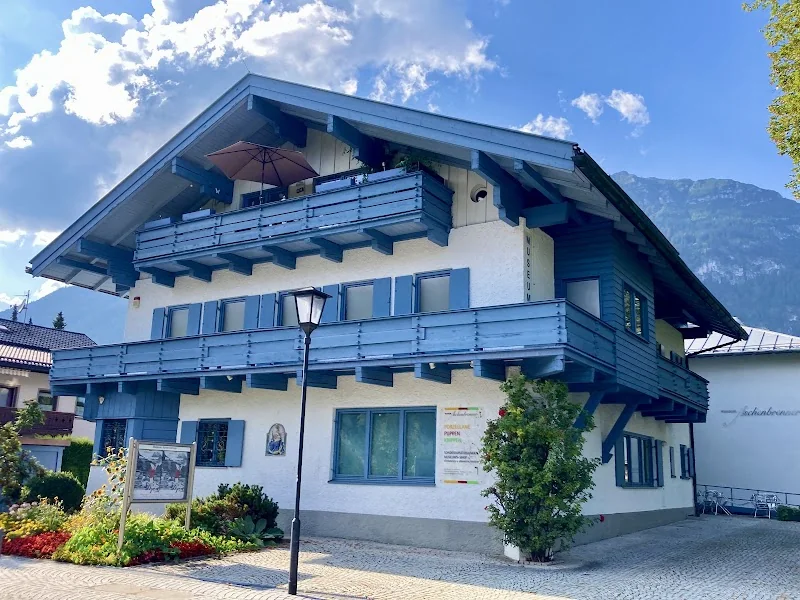
Loisachstraße 44, Garmisch-Partenkirchen
Loisachstraße 44, 82467 Garmisch-Partenkirchen, Germany
Museum Aschenbrenner | Porcelain & Dolls
The Museum Aschenbrenner in Garmisch-Partenkirchen is not a loud large museum, but a carefully composed cultural place with surprisingly much depth. On two floors, the doll and porcelain collection is housed in about 300 square meters; the house is complemented by a modern new building that houses the nativity scene exhibition and also provides space for events and special exhibitions. This very mix is what makes it appealing: When entering the museum, visitors do not simply experience individual showcases, but three thematically strong worlds that complement each other and together create a very personal image of art, everyday culture, memories, and regional collector passion. The house is wheelchair accessible, but currently, the elevator is out of order, so the doll exhibition and the exhibition of the Philatelia e.V. association are temporarily only accessible via the stairs. For visitors looking for a quiet, atmospheric, and at the same time content-rich museum visit, the Museum Aschenbrenner is therefore a characterful address that is wonderfully suitable for families, culture enthusiasts, and rainy days. ([museum-aschenbrenner.de](https://www.museum-aschenbrenner.de/))
Porcelain from the 18th Century and Meissen's White Gold
The porcelain collection is one of the strongest attractions of the museum. The term itself refers to a fascinating era when porcelain was considered a precious material and often described as white gold. The exhibition mainly showcases pieces from the early European porcelain production, a time when technical perfection, courtly taste, and political symbolism were closely intertwined. Particularly noteworthy is that alongside general insights into the development of porcelain, works by Johann Joachim Kändler and Johann Peter Melchior are also presented, two names that stand for the high art of modeling and are closely linked to European porcelain history. The exhibition not only tells of beautiful objects but also of how porcelain was used as a means of representation and politics. This makes the tour exciting for people who are interested not only in decorative items but also in cultural history in the true sense. Film material, images, and workshop insights additionally provide a glimpse into the famous Meissen manufactory and clarify why this production still has a special resonance today. At the same time, the staging opens up a picture of the Rococo world with harlequins, elegant ladies, and delicate shepherd motifs. The museum consciously works with atmosphere rather than mere object abundance: scent, music, and poetic elements are intended to transport visitors back to the 18th century and make the connection between art and feeling of life palpable. A special highlight of the collection is a Meissen pug from the 18th century, which impressively underscores the importance of attention to detail and the collector's eye. It is also interesting for international guests that the texts of the permanent exhibitions are available in English according to the official website. ([museum-aschenbrenner.de](https://www.museum-aschenbrenner.de/english-1/porcelain/))
For SEO searches related to museum aschenbrenner porcelain, museum aschenbrenner admission, and museum aschenbrenner opening hours, this section is particularly relevant because it makes the core content of the house visible: high-quality collection pieces, strong historical context, and a visit experience that combines knowledge and aesthetics. Those who know porcelain mainly as fine china will find a much broader perspective here. The exhibition shows that porcelain is not just a material but a cultural code. It stands for technical innovation, for courtly representation, and for the interplay of craftsmanship and art. This combination explains why the porcelain department is also interesting for people who are planning only a short stay in Garmisch-Partenkirchen. The tour is compact enough for a city visit but rich enough to remain in memory longer. Those looking for a museum that does not overwhelm but sets targeted accents will find a convincing balance here. The collection conveys attitude rather than mass, and therein lies its strength. ([museum-aschenbrenner.de](https://www.museum-aschenbrenner.de/english-1/porcelain/))
Dolls, Childhood, and the Play with Memories
The doll exhibition of the Museum Aschenbrenner speaks a different emotional language but is no less profound. The entrance is already remarkable: An old train carriage leads into the world of the 19th century and sets the tone for a journey into past childhoods. From there, the tour leads over elegant fashion ladies from France to the real play dolls of Käthe Kruse, that is, to those types of dolls that were not only looked at but actually used. The collection unites rare and precious specimens, often in original clothing and with surprising accessories. This creates a very immediate access to childhood, fashion, education, and the change in toy functions. The exhibition makes visible that dolls are not just toys but cultural testimonies. They reflect ideas of beauty, gender roles, educational ideals, and social status. This is precisely why this department is often just as touching for adults as it is for children. Many visitors recognize something from their own family history in the figures, and this recognition is an important part of the exhibition experience. At the same time, the presentation actively invites participation: One can feel different doll bodies, participate in the doll quiz, or write one's own doll story. Historical books and toys in the activity area give both small and large guests the opportunity to linger longer, discover, and engage in conversation. ([museum-aschenbrenner.de](https://www.museum-aschenbrenner.de/dauerausstellungen/puppen/))
Especially families looking for museum aschenbrenner children or museum aschenbrenner porcelain dolls will find a place here that does not create distance but rather closeness. The doll department is not just a silent showcase but an invitation to remember and tell stories. This fits perfectly with a house that operates strongly through collection, personality, and regional connection. The GaPa tourism site also describes the museum visit as an experience full of dolls and porcelain figures, with a play area, doll quiz, and changing special exhibitions. This shows that the museum is consciously perceived as a place for intergenerational discoveries in the local leisure offerings. Especially on days with changeable weather, this is an advantage because one does not just take a quick look inside but finds a genuine stop in the day's program. The doll exhibition thus offers not only nostalgia but also educational value and interaction. Those who follow the visitor guidance attentively will quickly notice that the objects are placed in a larger context: It is about the image of the child in different times, the role of toys in everyday life, and the emotional power of things that have been kept for a long time. This is precisely where the special warmth of this part of the museum arises. ([museum-aschenbrenner.de](https://www.museum-aschenbrenner.de/dauerausstellungen/puppen/))
Nativity Scenes from Four Centuries and Regional Traditions
The nativity scene exhibition complements the other two collections not only in content but also atmospherically. According to the official description, it includes 11 large nativity scenes from four centuries as well as numerous smaller nativity sets, individual figures, and valuable artworks from a monastic context. The presentation is understood as an expression of religious culture and primarily shows the tradition of nativity scenes in the Werdenfelser Land. This gives the museum a clearly recognizable regional anchoring: The objects do not stand isolated next to each other but in the context of local piety, craftsmanship, and traditional narrative forms. Particularly impressive is that the exhibition not only shows Bavarian and Alpine perspectives but also includes a Tyrolean paper nativity ensemble from the 18th century as well as oriental nativity scenes. This broadens the view beyond the region and makes clear that the nativity tradition knows many forms, materials, and styles. The diversity of the exhibits ensures that the visit is not limited to Christmas. Rather, it becomes visible how strongly nativity scenes are connected with identity, memory, and artistic imagination as cultural expressions. Together with the doll and porcelain collections, an exciting triad of childhood, craftsmanship, ritual, and collection culture emerges. The nativity scene department is therefore not only seasonally interesting but a reason to visit year-round. ([museum-aschenbrenner.de](https://www.museum-aschenbrenner.de/english-1/nativity-scenes/))
The architectural and organizational integration of this exhibition is also noteworthy. The modern new building of the museum houses the nativity scene exhibition and simultaneously creates space for events and special exhibitions. This means: The nativity scenes are not simply fitted into a historic old building but into an area that is deliberately designed for presentation and flexibility. For visitors, this is pleasant because the exhibition thus receives its own stage. Content-wise, this fits well with the museum's logic, as the nativity scenes represent a cultural practice that is still alive today and continues in various households, regions, and religious environments. The connection to the tradition of the Werdenfelser Land gives the whole a local color without narrowing the view. Those searching for museum aschenbrenner nativity scenes often want to see not just a single object but understand how nativity scenes function as a form of expression. This department achieves exactly that: It shows material diversity, regional roots, and historical depth. In combination with the collecting eye of the founder, it creates an exhibition that does not appear folkloric but is carefully and respectfully curated. This makes it equally attractive for families, those interested in cultural history, and local visitors. ([museum-aschenbrenner.de](https://www.museum-aschenbrenner.de/english-1/nativity-scenes/))
Opening Hours, Admission, and Accessibility
For practical planning, the museum is uncomplicated and clearly structured. It is open from Tuesday to Sunday and on holidays from 11 am to 5 pm. An additional partner source mentions Monday as the regular day of rest. This makes visit planning straightforward, especially for travelers who want to keep their stay in Garmisch-Partenkirchen flexible. The admission prices are also deliberately family-friendly: Adults pay 4.00 euros, reduced admission costs 3.50 euros, and children and teenagers up to 18 years have free access. Admission is also free for guests with a valid GaPa guest card. These conditions make the museum an attractive destination for a short museum visit, a family outing, or a rainy day alternative without major hurdles. At the same time, the house is wheelchair accessible, which is an important criterion for many guests. Those planning a limited stay can easily integrate the museum into a city stroll or a half-day in Garmisch-Partenkirchen. The visitor guidance is therefore not elitist but open and accessible. Particularly positive is that the permanent exhibitions are also explained in English, which facilitates access for international guests. Especially in a tourism region, this is a real plus because it makes the collection readable for people from abroad. ([museum-aschenbrenner.de](https://www.museum-aschenbrenner.de/))
An important current note concerns the building technology: The elevator is currently out of order. The official website explicitly points out that the doll exhibition and the exhibition of the Philatelia e.V. association are currently only accessible via the stairs. This is not a permanent quality deficiency but a relevant practical point for guests with mobility restrictions, strollers, or heavy luggage. Those who inform themselves in advance can plan their visit better and know exactly which areas are accessible. In the context of the search intent museum aschenbrenner accessible, this note is therefore particularly important. Additionally, the GaPa tourism site shows that the museum is also recommended in local communication as a good destination for bad weather days. This is understandable because the house functions compactly, with dense content and is independent of the weather. Instead of large areas and long paths, it offers concentrated exhibitions that can be explored in a calm atmosphere. Especially on gray days or in changeable Alpine weather, this is a real advantage. So, for those looking for a cultural alternative to outdoor programs, this is a destination that works well both thematically and organizationally. The combination of fair prices, clear opening hours, and wheelchair access makes the Museum Aschenbrenner a very accessible address in the town center of Garmisch-Partenkirchen. ([museum-aschenbrenner.de](https://www.museum-aschenbrenner.de/))
Directions, Group Offers, and Special Exhibitions
The museum is located at Loisachstraße 44 in Garmisch-Partenkirchen. The official arrival page of the museum integrates Google Maps so that visitors can locate the site directly. However, a specific parking list is not explicitly mentioned there, so concrete parking planning is best combined with the general possibilities of the town center. For guests who prefer to walk, the integration into the local area is very pleasant: The GaPa tourism route through Garmisch passes by Loisachstraße and explicitly mentions that the Museum Aschenbrenner is located here. In the family-oriented Loisls stamp rally, the museum is even station 4. This integration shows that the institution is not located off the beaten path but is well embedded in the tourist and urban exploration. So, for those wanting to combine a walk through Garmisch, a cultural stop, and a family-friendly program, this is a very suitable stop. The museum benefits from its location within a walkable discovery area where historical facades, museum offerings, and local history come together. This makes it easy to spontaneously include the visit. It is also important for families that the tourism site describes the museum as a place where there is much to discover, including a play area and doll quiz. ([museum-aschenbrenner.de](https://www.museum-aschenbrenner.de/das-museum-1/anreise/))
The house is also well set up for groups. According to the museum's website, guided tours can be booked for associations, colleague circles, or groups of friends. Guided tours through the permanent exhibitions or a tour of the current special exhibition are possible; individual arrangements can even be made outside regular opening hours. The costs are 50 euros per hour plus admission. Special programs for senior groups can be offered free of charge thanks to the Marianne Aschenbrenner Foundation. Educational offerings are also made for school classes and kindergarten groups, and birthday children can choose from various programs. This is important content-wise because it shows that the museum is not just a static exhibition site but also a lively mediation space. Additionally, the museum hosts two to three changing special exhibitions annually. This keeps the house dynamic and responsive to new themes beyond the permanent exhibitions. Those returning will not simply find the same program but can expect changing focuses. This mix of stability and variation is particularly valuable for a smaller museum. It allows for retaining regular guests while also appealing to new visitor groups. This is a strong argument for search queries like museum aschenbrenner special exhibitions or museum aschenbrenner group offers. ([museum-aschenbrenner.de](https://www.museum-aschenbrenner.de/veranstaltungen-museumsp%C3%A4dagogik/gruppenangebote/?utm_source=openai))
The tourism classification also speaks for the museum as a good destination in any weather. The GaPa tourism site explicitly names museums and events as meaningful alternatives for bad weather, and the Museum Aschenbrenner is linked there as a worthwhile stop. This means not only that the house is independent of the weather but also that it is perceived as a reliable cultural building block in the region. Those planning their day flexibly can easily switch between a walk, coffee house, city stroll, and museum visit. This combinability is typical for Garmisch-Partenkirchen and makes the place particularly attractive for guests. The museum fits into this rhythm because it neither appears too large nor too small and addresses very different visitor interests through its collection themes. Families come for dolls and nativity scenes, those interested in cultural history for porcelain, groups for the guided tours, and local guests for the changing special exhibitions. This creates a very broad usage profile that is as interesting for search engines as it is for real visitors. So, for those looking for a location that combines family experience, cultural mediation, and local relevance, the Museum Aschenbrenner is a convincing address with clear strengths. ([gapa-tourismus.de](https://www.gapa-tourismus.de/de/Sommer/Ausfl%25C3%25BCge/Schlechtwetter%2520Tipps))
The Founder Marianne Aschenbrenner and the History of the House
The history of the museum is closely linked to Marianne Aschenbrenner. She was born in 1928 in Düsseldorf but spent several years in Garmisch-Partenkirchen during World War II. Later, in the 1970s, she moved permanently to the town with her husband. In 1996, she founded a first foundation to promote art and culture. In the following years, she had an exhibition of her collections set up in the Kurhaus and stipulated that her assets should flow into her foundations after her death. Furthermore, her residence was to be converted into a museum for her collections and supplemented by an extension in which the local nativity scene association would have its own exhibition. With the opening of the Museum Aschenbrenner in July 2006, this will of the foundation was realized. This origin is central to the character of the house because it explains why the collection appears so personal. The museum did not arise from an abstract curatorial concept but from the passion of a collector who has brought her interest in art, culture, and memory objects into a lasting form. This gives the rooms their special mix of intimacy and museum care. ([museum-aschenbrenner.de](https://www.museum-aschenbrenner.de/das-museum-1/die-stifterin/))
The founder also shapes the content logic of the house. Porcelain, dolls, and nativity scenes are not randomly placed next to each other but reflect interests revolving around aesthetics, childhood, craftsmanship, and cultural memory. The museum has preserved this handwriting to this day. It remains no anonymous building but a place with a biography. This is important for visitors because the collection thereby gains a narrative level: One does not only view objects but simultaneously the life’s work of a woman who became at home in Garmisch-Partenkirchen and enriched the place with a cultural gem. The combination of private collecting passion and public mediation makes the museum timelessly interesting. It is locally rooted but thematically connected; historically grounded but not museum distanced; familial but by no means arbitrary. This is precisely why the Museum Aschenbrenner is so well suited for SEO texts with terms like museum aschenbrenner garmisch partenkirchen, museum aschenbrenner porcelain, museum aschenbrenner dolls, and museum aschenbrenner nativity scenes. The house unites several search intents in one address while remaining clearly profiled. Those who know the story of the founder also understand better why the exhibition is designed so lovingly, compactly, and in detail. It is not just a place of display but also of preservation. And therein lies its enduring strength. ([museum-aschenbrenner.de](https://www.museum-aschenbrenner.de/das-museum-1/die-stifterin/))
Sources:
Show moreShow less
Museum Aschenbrenner | Porcelain & Dolls
The Museum Aschenbrenner in Garmisch-Partenkirchen is not a loud large museum, but a carefully composed cultural place with surprisingly much depth. On two floors, the doll and porcelain collection is housed in about 300 square meters; the house is complemented by a modern new building that houses the nativity scene exhibition and also provides space for events and special exhibitions. This very mix is what makes it appealing: When entering the museum, visitors do not simply experience individual showcases, but three thematically strong worlds that complement each other and together create a very personal image of art, everyday culture, memories, and regional collector passion. The house is wheelchair accessible, but currently, the elevator is out of order, so the doll exhibition and the exhibition of the Philatelia e.V. association are temporarily only accessible via the stairs. For visitors looking for a quiet, atmospheric, and at the same time content-rich museum visit, the Museum Aschenbrenner is therefore a characterful address that is wonderfully suitable for families, culture enthusiasts, and rainy days. ([museum-aschenbrenner.de](https://www.museum-aschenbrenner.de/))
Porcelain from the 18th Century and Meissen's White Gold
The porcelain collection is one of the strongest attractions of the museum. The term itself refers to a fascinating era when porcelain was considered a precious material and often described as white gold. The exhibition mainly showcases pieces from the early European porcelain production, a time when technical perfection, courtly taste, and political symbolism were closely intertwined. Particularly noteworthy is that alongside general insights into the development of porcelain, works by Johann Joachim Kändler and Johann Peter Melchior are also presented, two names that stand for the high art of modeling and are closely linked to European porcelain history. The exhibition not only tells of beautiful objects but also of how porcelain was used as a means of representation and politics. This makes the tour exciting for people who are interested not only in decorative items but also in cultural history in the true sense. Film material, images, and workshop insights additionally provide a glimpse into the famous Meissen manufactory and clarify why this production still has a special resonance today. At the same time, the staging opens up a picture of the Rococo world with harlequins, elegant ladies, and delicate shepherd motifs. The museum consciously works with atmosphere rather than mere object abundance: scent, music, and poetic elements are intended to transport visitors back to the 18th century and make the connection between art and feeling of life palpable. A special highlight of the collection is a Meissen pug from the 18th century, which impressively underscores the importance of attention to detail and the collector's eye. It is also interesting for international guests that the texts of the permanent exhibitions are available in English according to the official website. ([museum-aschenbrenner.de](https://www.museum-aschenbrenner.de/english-1/porcelain/))
For SEO searches related to museum aschenbrenner porcelain, museum aschenbrenner admission, and museum aschenbrenner opening hours, this section is particularly relevant because it makes the core content of the house visible: high-quality collection pieces, strong historical context, and a visit experience that combines knowledge and aesthetics. Those who know porcelain mainly as fine china will find a much broader perspective here. The exhibition shows that porcelain is not just a material but a cultural code. It stands for technical innovation, for courtly representation, and for the interplay of craftsmanship and art. This combination explains why the porcelain department is also interesting for people who are planning only a short stay in Garmisch-Partenkirchen. The tour is compact enough for a city visit but rich enough to remain in memory longer. Those looking for a museum that does not overwhelm but sets targeted accents will find a convincing balance here. The collection conveys attitude rather than mass, and therein lies its strength. ([museum-aschenbrenner.de](https://www.museum-aschenbrenner.de/english-1/porcelain/))
Dolls, Childhood, and the Play with Memories
The doll exhibition of the Museum Aschenbrenner speaks a different emotional language but is no less profound. The entrance is already remarkable: An old train carriage leads into the world of the 19th century and sets the tone for a journey into past childhoods. From there, the tour leads over elegant fashion ladies from France to the real play dolls of Käthe Kruse, that is, to those types of dolls that were not only looked at but actually used. The collection unites rare and precious specimens, often in original clothing and with surprising accessories. This creates a very immediate access to childhood, fashion, education, and the change in toy functions. The exhibition makes visible that dolls are not just toys but cultural testimonies. They reflect ideas of beauty, gender roles, educational ideals, and social status. This is precisely why this department is often just as touching for adults as it is for children. Many visitors recognize something from their own family history in the figures, and this recognition is an important part of the exhibition experience. At the same time, the presentation actively invites participation: One can feel different doll bodies, participate in the doll quiz, or write one's own doll story. Historical books and toys in the activity area give both small and large guests the opportunity to linger longer, discover, and engage in conversation. ([museum-aschenbrenner.de](https://www.museum-aschenbrenner.de/dauerausstellungen/puppen/))
Especially families looking for museum aschenbrenner children or museum aschenbrenner porcelain dolls will find a place here that does not create distance but rather closeness. The doll department is not just a silent showcase but an invitation to remember and tell stories. This fits perfectly with a house that operates strongly through collection, personality, and regional connection. The GaPa tourism site also describes the museum visit as an experience full of dolls and porcelain figures, with a play area, doll quiz, and changing special exhibitions. This shows that the museum is consciously perceived as a place for intergenerational discoveries in the local leisure offerings. Especially on days with changeable weather, this is an advantage because one does not just take a quick look inside but finds a genuine stop in the day's program. The doll exhibition thus offers not only nostalgia but also educational value and interaction. Those who follow the visitor guidance attentively will quickly notice that the objects are placed in a larger context: It is about the image of the child in different times, the role of toys in everyday life, and the emotional power of things that have been kept for a long time. This is precisely where the special warmth of this part of the museum arises. ([museum-aschenbrenner.de](https://www.museum-aschenbrenner.de/dauerausstellungen/puppen/))
Nativity Scenes from Four Centuries and Regional Traditions
The nativity scene exhibition complements the other two collections not only in content but also atmospherically. According to the official description, it includes 11 large nativity scenes from four centuries as well as numerous smaller nativity sets, individual figures, and valuable artworks from a monastic context. The presentation is understood as an expression of religious culture and primarily shows the tradition of nativity scenes in the Werdenfelser Land. This gives the museum a clearly recognizable regional anchoring: The objects do not stand isolated next to each other but in the context of local piety, craftsmanship, and traditional narrative forms. Particularly impressive is that the exhibition not only shows Bavarian and Alpine perspectives but also includes a Tyrolean paper nativity ensemble from the 18th century as well as oriental nativity scenes. This broadens the view beyond the region and makes clear that the nativity tradition knows many forms, materials, and styles. The diversity of the exhibits ensures that the visit is not limited to Christmas. Rather, it becomes visible how strongly nativity scenes are connected with identity, memory, and artistic imagination as cultural expressions. Together with the doll and porcelain collections, an exciting triad of childhood, craftsmanship, ritual, and collection culture emerges. The nativity scene department is therefore not only seasonally interesting but a reason to visit year-round. ([museum-aschenbrenner.de](https://www.museum-aschenbrenner.de/english-1/nativity-scenes/))
The architectural and organizational integration of this exhibition is also noteworthy. The modern new building of the museum houses the nativity scene exhibition and simultaneously creates space for events and special exhibitions. This means: The nativity scenes are not simply fitted into a historic old building but into an area that is deliberately designed for presentation and flexibility. For visitors, this is pleasant because the exhibition thus receives its own stage. Content-wise, this fits well with the museum's logic, as the nativity scenes represent a cultural practice that is still alive today and continues in various households, regions, and religious environments. The connection to the tradition of the Werdenfelser Land gives the whole a local color without narrowing the view. Those searching for museum aschenbrenner nativity scenes often want to see not just a single object but understand how nativity scenes function as a form of expression. This department achieves exactly that: It shows material diversity, regional roots, and historical depth. In combination with the collecting eye of the founder, it creates an exhibition that does not appear folkloric but is carefully and respectfully curated. This makes it equally attractive for families, those interested in cultural history, and local visitors. ([museum-aschenbrenner.de](https://www.museum-aschenbrenner.de/english-1/nativity-scenes/))
Opening Hours, Admission, and Accessibility
For practical planning, the museum is uncomplicated and clearly structured. It is open from Tuesday to Sunday and on holidays from 11 am to 5 pm. An additional partner source mentions Monday as the regular day of rest. This makes visit planning straightforward, especially for travelers who want to keep their stay in Garmisch-Partenkirchen flexible. The admission prices are also deliberately family-friendly: Adults pay 4.00 euros, reduced admission costs 3.50 euros, and children and teenagers up to 18 years have free access. Admission is also free for guests with a valid GaPa guest card. These conditions make the museum an attractive destination for a short museum visit, a family outing, or a rainy day alternative without major hurdles. At the same time, the house is wheelchair accessible, which is an important criterion for many guests. Those planning a limited stay can easily integrate the museum into a city stroll or a half-day in Garmisch-Partenkirchen. The visitor guidance is therefore not elitist but open and accessible. Particularly positive is that the permanent exhibitions are also explained in English, which facilitates access for international guests. Especially in a tourism region, this is a real plus because it makes the collection readable for people from abroad. ([museum-aschenbrenner.de](https://www.museum-aschenbrenner.de/))
An important current note concerns the building technology: The elevator is currently out of order. The official website explicitly points out that the doll exhibition and the exhibition of the Philatelia e.V. association are currently only accessible via the stairs. This is not a permanent quality deficiency but a relevant practical point for guests with mobility restrictions, strollers, or heavy luggage. Those who inform themselves in advance can plan their visit better and know exactly which areas are accessible. In the context of the search intent museum aschenbrenner accessible, this note is therefore particularly important. Additionally, the GaPa tourism site shows that the museum is also recommended in local communication as a good destination for bad weather days. This is understandable because the house functions compactly, with dense content and is independent of the weather. Instead of large areas and long paths, it offers concentrated exhibitions that can be explored in a calm atmosphere. Especially on gray days or in changeable Alpine weather, this is a real advantage. So, for those looking for a cultural alternative to outdoor programs, this is a destination that works well both thematically and organizationally. The combination of fair prices, clear opening hours, and wheelchair access makes the Museum Aschenbrenner a very accessible address in the town center of Garmisch-Partenkirchen. ([museum-aschenbrenner.de](https://www.museum-aschenbrenner.de/))
Directions, Group Offers, and Special Exhibitions
The museum is located at Loisachstraße 44 in Garmisch-Partenkirchen. The official arrival page of the museum integrates Google Maps so that visitors can locate the site directly. However, a specific parking list is not explicitly mentioned there, so concrete parking planning is best combined with the general possibilities of the town center. For guests who prefer to walk, the integration into the local area is very pleasant: The GaPa tourism route through Garmisch passes by Loisachstraße and explicitly mentions that the Museum Aschenbrenner is located here. In the family-oriented Loisls stamp rally, the museum is even station 4. This integration shows that the institution is not located off the beaten path but is well embedded in the tourist and urban exploration. So, for those wanting to combine a walk through Garmisch, a cultural stop, and a family-friendly program, this is a very suitable stop. The museum benefits from its location within a walkable discovery area where historical facades, museum offerings, and local history come together. This makes it easy to spontaneously include the visit. It is also important for families that the tourism site describes the museum as a place where there is much to discover, including a play area and doll quiz. ([museum-aschenbrenner.de](https://www.museum-aschenbrenner.de/das-museum-1/anreise/))
The house is also well set up for groups. According to the museum's website, guided tours can be booked for associations, colleague circles, or groups of friends. Guided tours through the permanent exhibitions or a tour of the current special exhibition are possible; individual arrangements can even be made outside regular opening hours. The costs are 50 euros per hour plus admission. Special programs for senior groups can be offered free of charge thanks to the Marianne Aschenbrenner Foundation. Educational offerings are also made for school classes and kindergarten groups, and birthday children can choose from various programs. This is important content-wise because it shows that the museum is not just a static exhibition site but also a lively mediation space. Additionally, the museum hosts two to three changing special exhibitions annually. This keeps the house dynamic and responsive to new themes beyond the permanent exhibitions. Those returning will not simply find the same program but can expect changing focuses. This mix of stability and variation is particularly valuable for a smaller museum. It allows for retaining regular guests while also appealing to new visitor groups. This is a strong argument for search queries like museum aschenbrenner special exhibitions or museum aschenbrenner group offers. ([museum-aschenbrenner.de](https://www.museum-aschenbrenner.de/veranstaltungen-museumsp%C3%A4dagogik/gruppenangebote/?utm_source=openai))
The tourism classification also speaks for the museum as a good destination in any weather. The GaPa tourism site explicitly names museums and events as meaningful alternatives for bad weather, and the Museum Aschenbrenner is linked there as a worthwhile stop. This means not only that the house is independent of the weather but also that it is perceived as a reliable cultural building block in the region. Those planning their day flexibly can easily switch between a walk, coffee house, city stroll, and museum visit. This combinability is typical for Garmisch-Partenkirchen and makes the place particularly attractive for guests. The museum fits into this rhythm because it neither appears too large nor too small and addresses very different visitor interests through its collection themes. Families come for dolls and nativity scenes, those interested in cultural history for porcelain, groups for the guided tours, and local guests for the changing special exhibitions. This creates a very broad usage profile that is as interesting for search engines as it is for real visitors. So, for those looking for a location that combines family experience, cultural mediation, and local relevance, the Museum Aschenbrenner is a convincing address with clear strengths. ([gapa-tourismus.de](https://www.gapa-tourismus.de/de/Sommer/Ausfl%25C3%25BCge/Schlechtwetter%2520Tipps))
The Founder Marianne Aschenbrenner and the History of the House
The history of the museum is closely linked to Marianne Aschenbrenner. She was born in 1928 in Düsseldorf but spent several years in Garmisch-Partenkirchen during World War II. Later, in the 1970s, she moved permanently to the town with her husband. In 1996, she founded a first foundation to promote art and culture. In the following years, she had an exhibition of her collections set up in the Kurhaus and stipulated that her assets should flow into her foundations after her death. Furthermore, her residence was to be converted into a museum for her collections and supplemented by an extension in which the local nativity scene association would have its own exhibition. With the opening of the Museum Aschenbrenner in July 2006, this will of the foundation was realized. This origin is central to the character of the house because it explains why the collection appears so personal. The museum did not arise from an abstract curatorial concept but from the passion of a collector who has brought her interest in art, culture, and memory objects into a lasting form. This gives the rooms their special mix of intimacy and museum care. ([museum-aschenbrenner.de](https://www.museum-aschenbrenner.de/das-museum-1/die-stifterin/))
The founder also shapes the content logic of the house. Porcelain, dolls, and nativity scenes are not randomly placed next to each other but reflect interests revolving around aesthetics, childhood, craftsmanship, and cultural memory. The museum has preserved this handwriting to this day. It remains no anonymous building but a place with a biography. This is important for visitors because the collection thereby gains a narrative level: One does not only view objects but simultaneously the life’s work of a woman who became at home in Garmisch-Partenkirchen and enriched the place with a cultural gem. The combination of private collecting passion and public mediation makes the museum timelessly interesting. It is locally rooted but thematically connected; historically grounded but not museum distanced; familial but by no means arbitrary. This is precisely why the Museum Aschenbrenner is so well suited for SEO texts with terms like museum aschenbrenner garmisch partenkirchen, museum aschenbrenner porcelain, museum aschenbrenner dolls, and museum aschenbrenner nativity scenes. The house unites several search intents in one address while remaining clearly profiled. Those who know the story of the founder also understand better why the exhibition is designed so lovingly, compactly, and in detail. It is not just a place of display but also of preservation. And therein lies its enduring strength. ([museum-aschenbrenner.de](https://www.museum-aschenbrenner.de/das-museum-1/die-stifterin/))
Sources:
Museum Aschenbrenner | Porcelain & Dolls
The Museum Aschenbrenner in Garmisch-Partenkirchen is not a loud large museum, but a carefully composed cultural place with surprisingly much depth. On two floors, the doll and porcelain collection is housed in about 300 square meters; the house is complemented by a modern new building that houses the nativity scene exhibition and also provides space for events and special exhibitions. This very mix is what makes it appealing: When entering the museum, visitors do not simply experience individual showcases, but three thematically strong worlds that complement each other and together create a very personal image of art, everyday culture, memories, and regional collector passion. The house is wheelchair accessible, but currently, the elevator is out of order, so the doll exhibition and the exhibition of the Philatelia e.V. association are temporarily only accessible via the stairs. For visitors looking for a quiet, atmospheric, and at the same time content-rich museum visit, the Museum Aschenbrenner is therefore a characterful address that is wonderfully suitable for families, culture enthusiasts, and rainy days. ([museum-aschenbrenner.de](https://www.museum-aschenbrenner.de/))
Porcelain from the 18th Century and Meissen's White Gold
The porcelain collection is one of the strongest attractions of the museum. The term itself refers to a fascinating era when porcelain was considered a precious material and often described as white gold. The exhibition mainly showcases pieces from the early European porcelain production, a time when technical perfection, courtly taste, and political symbolism were closely intertwined. Particularly noteworthy is that alongside general insights into the development of porcelain, works by Johann Joachim Kändler and Johann Peter Melchior are also presented, two names that stand for the high art of modeling and are closely linked to European porcelain history. The exhibition not only tells of beautiful objects but also of how porcelain was used as a means of representation and politics. This makes the tour exciting for people who are interested not only in decorative items but also in cultural history in the true sense. Film material, images, and workshop insights additionally provide a glimpse into the famous Meissen manufactory and clarify why this production still has a special resonance today. At the same time, the staging opens up a picture of the Rococo world with harlequins, elegant ladies, and delicate shepherd motifs. The museum consciously works with atmosphere rather than mere object abundance: scent, music, and poetic elements are intended to transport visitors back to the 18th century and make the connection between art and feeling of life palpable. A special highlight of the collection is a Meissen pug from the 18th century, which impressively underscores the importance of attention to detail and the collector's eye. It is also interesting for international guests that the texts of the permanent exhibitions are available in English according to the official website. ([museum-aschenbrenner.de](https://www.museum-aschenbrenner.de/english-1/porcelain/))
For SEO searches related to museum aschenbrenner porcelain, museum aschenbrenner admission, and museum aschenbrenner opening hours, this section is particularly relevant because it makes the core content of the house visible: high-quality collection pieces, strong historical context, and a visit experience that combines knowledge and aesthetics. Those who know porcelain mainly as fine china will find a much broader perspective here. The exhibition shows that porcelain is not just a material but a cultural code. It stands for technical innovation, for courtly representation, and for the interplay of craftsmanship and art. This combination explains why the porcelain department is also interesting for people who are planning only a short stay in Garmisch-Partenkirchen. The tour is compact enough for a city visit but rich enough to remain in memory longer. Those looking for a museum that does not overwhelm but sets targeted accents will find a convincing balance here. The collection conveys attitude rather than mass, and therein lies its strength. ([museum-aschenbrenner.de](https://www.museum-aschenbrenner.de/english-1/porcelain/))
Dolls, Childhood, and the Play with Memories
The doll exhibition of the Museum Aschenbrenner speaks a different emotional language but is no less profound. The entrance is already remarkable: An old train carriage leads into the world of the 19th century and sets the tone for a journey into past childhoods. From there, the tour leads over elegant fashion ladies from France to the real play dolls of Käthe Kruse, that is, to those types of dolls that were not only looked at but actually used. The collection unites rare and precious specimens, often in original clothing and with surprising accessories. This creates a very immediate access to childhood, fashion, education, and the change in toy functions. The exhibition makes visible that dolls are not just toys but cultural testimonies. They reflect ideas of beauty, gender roles, educational ideals, and social status. This is precisely why this department is often just as touching for adults as it is for children. Many visitors recognize something from their own family history in the figures, and this recognition is an important part of the exhibition experience. At the same time, the presentation actively invites participation: One can feel different doll bodies, participate in the doll quiz, or write one's own doll story. Historical books and toys in the activity area give both small and large guests the opportunity to linger longer, discover, and engage in conversation. ([museum-aschenbrenner.de](https://www.museum-aschenbrenner.de/dauerausstellungen/puppen/))
Especially families looking for museum aschenbrenner children or museum aschenbrenner porcelain dolls will find a place here that does not create distance but rather closeness. The doll department is not just a silent showcase but an invitation to remember and tell stories. This fits perfectly with a house that operates strongly through collection, personality, and regional connection. The GaPa tourism site also describes the museum visit as an experience full of dolls and porcelain figures, with a play area, doll quiz, and changing special exhibitions. This shows that the museum is consciously perceived as a place for intergenerational discoveries in the local leisure offerings. Especially on days with changeable weather, this is an advantage because one does not just take a quick look inside but finds a genuine stop in the day's program. The doll exhibition thus offers not only nostalgia but also educational value and interaction. Those who follow the visitor guidance attentively will quickly notice that the objects are placed in a larger context: It is about the image of the child in different times, the role of toys in everyday life, and the emotional power of things that have been kept for a long time. This is precisely where the special warmth of this part of the museum arises. ([museum-aschenbrenner.de](https://www.museum-aschenbrenner.de/dauerausstellungen/puppen/))
Nativity Scenes from Four Centuries and Regional Traditions
The nativity scene exhibition complements the other two collections not only in content but also atmospherically. According to the official description, it includes 11 large nativity scenes from four centuries as well as numerous smaller nativity sets, individual figures, and valuable artworks from a monastic context. The presentation is understood as an expression of religious culture and primarily shows the tradition of nativity scenes in the Werdenfelser Land. This gives the museum a clearly recognizable regional anchoring: The objects do not stand isolated next to each other but in the context of local piety, craftsmanship, and traditional narrative forms. Particularly impressive is that the exhibition not only shows Bavarian and Alpine perspectives but also includes a Tyrolean paper nativity ensemble from the 18th century as well as oriental nativity scenes. This broadens the view beyond the region and makes clear that the nativity tradition knows many forms, materials, and styles. The diversity of the exhibits ensures that the visit is not limited to Christmas. Rather, it becomes visible how strongly nativity scenes are connected with identity, memory, and artistic imagination as cultural expressions. Together with the doll and porcelain collections, an exciting triad of childhood, craftsmanship, ritual, and collection culture emerges. The nativity scene department is therefore not only seasonally interesting but a reason to visit year-round. ([museum-aschenbrenner.de](https://www.museum-aschenbrenner.de/english-1/nativity-scenes/))
The architectural and organizational integration of this exhibition is also noteworthy. The modern new building of the museum houses the nativity scene exhibition and simultaneously creates space for events and special exhibitions. This means: The nativity scenes are not simply fitted into a historic old building but into an area that is deliberately designed for presentation and flexibility. For visitors, this is pleasant because the exhibition thus receives its own stage. Content-wise, this fits well with the museum's logic, as the nativity scenes represent a cultural practice that is still alive today and continues in various households, regions, and religious environments. The connection to the tradition of the Werdenfelser Land gives the whole a local color without narrowing the view. Those searching for museum aschenbrenner nativity scenes often want to see not just a single object but understand how nativity scenes function as a form of expression. This department achieves exactly that: It shows material diversity, regional roots, and historical depth. In combination with the collecting eye of the founder, it creates an exhibition that does not appear folkloric but is carefully and respectfully curated. This makes it equally attractive for families, those interested in cultural history, and local visitors. ([museum-aschenbrenner.de](https://www.museum-aschenbrenner.de/english-1/nativity-scenes/))
Opening Hours, Admission, and Accessibility
For practical planning, the museum is uncomplicated and clearly structured. It is open from Tuesday to Sunday and on holidays from 11 am to 5 pm. An additional partner source mentions Monday as the regular day of rest. This makes visit planning straightforward, especially for travelers who want to keep their stay in Garmisch-Partenkirchen flexible. The admission prices are also deliberately family-friendly: Adults pay 4.00 euros, reduced admission costs 3.50 euros, and children and teenagers up to 18 years have free access. Admission is also free for guests with a valid GaPa guest card. These conditions make the museum an attractive destination for a short museum visit, a family outing, or a rainy day alternative without major hurdles. At the same time, the house is wheelchair accessible, which is an important criterion for many guests. Those planning a limited stay can easily integrate the museum into a city stroll or a half-day in Garmisch-Partenkirchen. The visitor guidance is therefore not elitist but open and accessible. Particularly positive is that the permanent exhibitions are also explained in English, which facilitates access for international guests. Especially in a tourism region, this is a real plus because it makes the collection readable for people from abroad. ([museum-aschenbrenner.de](https://www.museum-aschenbrenner.de/))
An important current note concerns the building technology: The elevator is currently out of order. The official website explicitly points out that the doll exhibition and the exhibition of the Philatelia e.V. association are currently only accessible via the stairs. This is not a permanent quality deficiency but a relevant practical point for guests with mobility restrictions, strollers, or heavy luggage. Those who inform themselves in advance can plan their visit better and know exactly which areas are accessible. In the context of the search intent museum aschenbrenner accessible, this note is therefore particularly important. Additionally, the GaPa tourism site shows that the museum is also recommended in local communication as a good destination for bad weather days. This is understandable because the house functions compactly, with dense content and is independent of the weather. Instead of large areas and long paths, it offers concentrated exhibitions that can be explored in a calm atmosphere. Especially on gray days or in changeable Alpine weather, this is a real advantage. So, for those looking for a cultural alternative to outdoor programs, this is a destination that works well both thematically and organizationally. The combination of fair prices, clear opening hours, and wheelchair access makes the Museum Aschenbrenner a very accessible address in the town center of Garmisch-Partenkirchen. ([museum-aschenbrenner.de](https://www.museum-aschenbrenner.de/))
Directions, Group Offers, and Special Exhibitions
The museum is located at Loisachstraße 44 in Garmisch-Partenkirchen. The official arrival page of the museum integrates Google Maps so that visitors can locate the site directly. However, a specific parking list is not explicitly mentioned there, so concrete parking planning is best combined with the general possibilities of the town center. For guests who prefer to walk, the integration into the local area is very pleasant: The GaPa tourism route through Garmisch passes by Loisachstraße and explicitly mentions that the Museum Aschenbrenner is located here. In the family-oriented Loisls stamp rally, the museum is even station 4. This integration shows that the institution is not located off the beaten path but is well embedded in the tourist and urban exploration. So, for those wanting to combine a walk through Garmisch, a cultural stop, and a family-friendly program, this is a very suitable stop. The museum benefits from its location within a walkable discovery area where historical facades, museum offerings, and local history come together. This makes it easy to spontaneously include the visit. It is also important for families that the tourism site describes the museum as a place where there is much to discover, including a play area and doll quiz. ([museum-aschenbrenner.de](https://www.museum-aschenbrenner.de/das-museum-1/anreise/))
The house is also well set up for groups. According to the museum's website, guided tours can be booked for associations, colleague circles, or groups of friends. Guided tours through the permanent exhibitions or a tour of the current special exhibition are possible; individual arrangements can even be made outside regular opening hours. The costs are 50 euros per hour plus admission. Special programs for senior groups can be offered free of charge thanks to the Marianne Aschenbrenner Foundation. Educational offerings are also made for school classes and kindergarten groups, and birthday children can choose from various programs. This is important content-wise because it shows that the museum is not just a static exhibition site but also a lively mediation space. Additionally, the museum hosts two to three changing special exhibitions annually. This keeps the house dynamic and responsive to new themes beyond the permanent exhibitions. Those returning will not simply find the same program but can expect changing focuses. This mix of stability and variation is particularly valuable for a smaller museum. It allows for retaining regular guests while also appealing to new visitor groups. This is a strong argument for search queries like museum aschenbrenner special exhibitions or museum aschenbrenner group offers. ([museum-aschenbrenner.de](https://www.museum-aschenbrenner.de/veranstaltungen-museumsp%C3%A4dagogik/gruppenangebote/?utm_source=openai))
The tourism classification also speaks for the museum as a good destination in any weather. The GaPa tourism site explicitly names museums and events as meaningful alternatives for bad weather, and the Museum Aschenbrenner is linked there as a worthwhile stop. This means not only that the house is independent of the weather but also that it is perceived as a reliable cultural building block in the region. Those planning their day flexibly can easily switch between a walk, coffee house, city stroll, and museum visit. This combinability is typical for Garmisch-Partenkirchen and makes the place particularly attractive for guests. The museum fits into this rhythm because it neither appears too large nor too small and addresses very different visitor interests through its collection themes. Families come for dolls and nativity scenes, those interested in cultural history for porcelain, groups for the guided tours, and local guests for the changing special exhibitions. This creates a very broad usage profile that is as interesting for search engines as it is for real visitors. So, for those looking for a location that combines family experience, cultural mediation, and local relevance, the Museum Aschenbrenner is a convincing address with clear strengths. ([gapa-tourismus.de](https://www.gapa-tourismus.de/de/Sommer/Ausfl%25C3%25BCge/Schlechtwetter%2520Tipps))
The Founder Marianne Aschenbrenner and the History of the House
The history of the museum is closely linked to Marianne Aschenbrenner. She was born in 1928 in Düsseldorf but spent several years in Garmisch-Partenkirchen during World War II. Later, in the 1970s, she moved permanently to the town with her husband. In 1996, she founded a first foundation to promote art and culture. In the following years, she had an exhibition of her collections set up in the Kurhaus and stipulated that her assets should flow into her foundations after her death. Furthermore, her residence was to be converted into a museum for her collections and supplemented by an extension in which the local nativity scene association would have its own exhibition. With the opening of the Museum Aschenbrenner in July 2006, this will of the foundation was realized. This origin is central to the character of the house because it explains why the collection appears so personal. The museum did not arise from an abstract curatorial concept but from the passion of a collector who has brought her interest in art, culture, and memory objects into a lasting form. This gives the rooms their special mix of intimacy and museum care. ([museum-aschenbrenner.de](https://www.museum-aschenbrenner.de/das-museum-1/die-stifterin/))
The founder also shapes the content logic of the house. Porcelain, dolls, and nativity scenes are not randomly placed next to each other but reflect interests revolving around aesthetics, childhood, craftsmanship, and cultural memory. The museum has preserved this handwriting to this day. It remains no anonymous building but a place with a biography. This is important for visitors because the collection thereby gains a narrative level: One does not only view objects but simultaneously the life’s work of a woman who became at home in Garmisch-Partenkirchen and enriched the place with a cultural gem. The combination of private collecting passion and public mediation makes the museum timelessly interesting. It is locally rooted but thematically connected; historically grounded but not museum distanced; familial but by no means arbitrary. This is precisely why the Museum Aschenbrenner is so well suited for SEO texts with terms like museum aschenbrenner garmisch partenkirchen, museum aschenbrenner porcelain, museum aschenbrenner dolls, and museum aschenbrenner nativity scenes. The house unites several search intents in one address while remaining clearly profiled. Those who know the story of the founder also understand better why the exhibition is designed so lovingly, compactly, and in detail. It is not just a place of display but also of preservation. And therein lies its enduring strength. ([museum-aschenbrenner.de](https://www.museum-aschenbrenner.de/das-museum-1/die-stifterin/))
Sources:
Upcoming Events
No events found
Frequently Asked Questions
Reviews
Motoko Yagi
27. September 2025
The exhibit collection is very high quality and interesting, especially I enjoyed the porcelain exhibition since I visited the Meissen factory and joined a guided tour before. When I saw the exhibit and told the lady about my Meissen factory visit, she offered to show me a Meissen video, which was very informative and interesting about how Meissen makes porcelain. She also told me that she visited Japan last year and enjoyed that trip so much. I really enjoyed talking with her, and it was a pleasant experience for me.
Roksana Krzemińska
8. June 2019
The lady at the reception is absolutely lovely! The place itself is a great choice, especially for bad weather afternoons. Kids loved it! They also have a separate space for the so-called Kinderecke, so reserve some extra time to let the kids play and have fun.
dirty chimp
21. June 2024
Built and maintained with love. But small, and little to no English translations on the exhibits.
taghreed
11. June 2019
It is nice but small.
Steven Toner
29. January 2023
Cool small museum for old dolls.